How Long Does It Take to Get to Mars?
Movies make Mars look like a weekend drive. The real trip runs the better part of a year, follows a long curve, and can only begin on rare dates. Here is the reason.
Ask most people how far away Mars is and they picture something like a long flight. The honest answer is that a spacecraft leaving Earth today would not reach Mars until roughly next spring. It is one of the closest planets to us, and getting there still takes the better part of a year, for reasons that have more to do with orbits than with engine power.
In brief
With current rockets, a trip to Mars takes about seven to nine months. Spacecraft do not fly in a straight line; they follow a long curved path called a Hohmann transfer orbit, timed so the craft and Mars arrive at the same point at the same moment. Because that alignment only happens every 26 months, you can only launch during a short window that opens roughly every two years.
The trip is about seven to nine months
Real missions give the clearest answer. NASA’s Perseverance rover launched on July 30, 2020, and touched down on Mars on February 18, 2021, a journey of about seven months. Most robotic missions land in the same six-to-nine-month range, and the standard fuel-saving route, the Hohmann transfer, works out to roughly 259 days, or about eight and a half months.
That figure is remarkably stable across missions because it is set by physics rather than by how big your rocket is. A more powerful engine can shave some time, but the efficient path to Mars has a natural duration, and it lands close to seven months again and again.
Why you can’t just fly straight there
Here is the part that trips people up. You cannot aim a spacecraft at Mars and fire, because by the time you arrived, Mars would have moved on. Both planets are racing around the Sun at different speeds, so the target is never where you point.
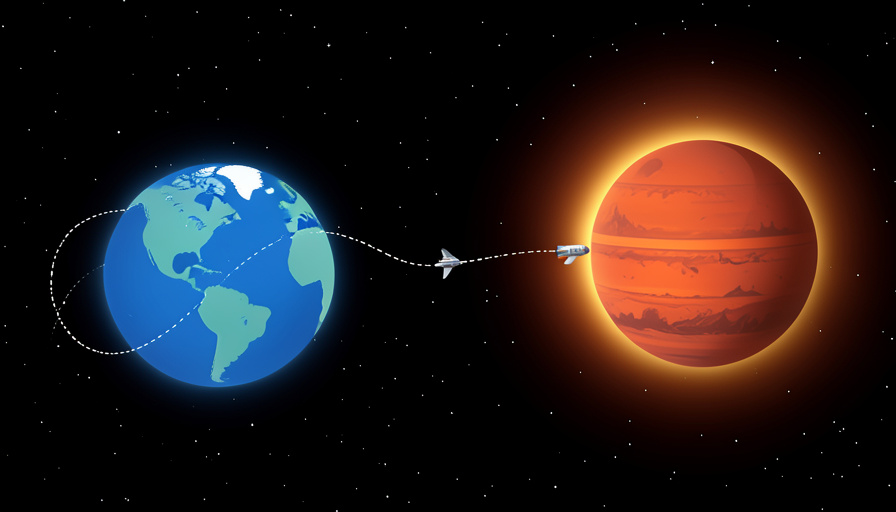
Instead, mission planners use a Hohmann transfer orbit, a stretched ellipse that leaves Earth’s orbit on one side and just reaches Mars’s orbit on the other. The spacecraft is launched when Mars is still well behind the meeting point, and it coasts along that curve so that Mars sweeps in exactly as the craft arrives. You aim at where Mars will be when the craft shows up, the way you throw a ball ahead of a running teammate instead of straight at them.
Why you can only leave every two years
That timing trick only lines up occasionally. Earth laps Mars around the Sun, and the two planets return to a launch-friendly arrangement about every 26 months, a stretch astronomers call the synodic period. Miss the window and you wait more than two years for the next one.
This is why Mars missions from different countries tend to launch in a cluster within a few weeks of each other, then nothing goes for two years. As NASA’s JPL explainer on launch windows lays out, agencies plan years ahead around these openings, because the calendar, not the countdown, is the real constraint. For more from beyond Earth, browse SciExaminer’s Space section.
How far away Mars really is
Part of what makes the trip strange is that there is no single distance to Mars. It changes constantly as both planets orbit.
- At a close, favorable alignment, Mars sits around 54 million kilometers from Earth.
- On average, the gap is closer to 225 million kilometers.
- When the two are on opposite sides of the Sun, Mars is more than 400 million kilometers away.
The distance also shows up in communication. A radio signal, moving at the speed of light, takes anywhere from about 3 minutes to 22 minutes to travel one way, depending on where the planets are. A live conversation with Mars is impossible; you send a message and wait.
Could we ever get there faster?
In principle, yes, and this is where crewed plans get interesting. Chemical rockets, the kind used today, are near their practical limit for this route, which is why the number keeps landing around seven months. Cutting that down means a different kind of engine.
Nuclear thermal and nuclear electric propulsion are the leading candidates, and space agencies are actively testing the idea because a faster transit means less time for astronauts exposed to space radiation. Those engines could eventually trim a crewed trip well below the current window, but they are still in development. For now, if someone asks how long it takes to get to Mars, seven months is the honest answer. For more science explainers, the Science section covers related ground.
At a glance
- A Mars trip takes roughly seven to nine months with today’s rockets; Perseverance took about seven.
- Spacecraft follow a curved Hohmann transfer orbit and aim for where Mars will be, not where it is.
- Launch windows open only about every 26 months, when Earth and Mars align favorably.
- The distance ranges from about 54 million to over 400 million kilometers as both planets orbit.
Frequently asked questions
How long does it take to get to Mars?
With current rockets, about seven to nine months. NASA’s Perseverance rover made the trip in roughly seven months, and the standard efficient route averages around 259 days.
Why does it take so long if Mars is close?
Spacecraft follow a long curved path rather than a straight line, and they have to launch when the two planets are aligned so Mars arrives at the meeting point at the same time as the craft. Physics, not engine power, sets the duration.
How often can you launch to Mars?
About every 26 months. That is how long it takes Earth and Mars to return to a launch-favorable alignment, so missions cluster in short windows and then pause for over two years.
How far is Mars from Earth?
It varies constantly. Mars can be as close as about 54 million kilometers at a favorable alignment and more than 400 million kilometers away when the planets are on opposite sides of the Sun.
Could future spacecraft reach Mars faster?
Possibly. Nuclear thermal and electric propulsion could shorten crewed trips below the current seven-month figure, which would reduce astronauts’ radiation exposure, but those engines are still being developed.
Final takeaway
Mars is a neighbor, but reaching it is governed by orbital timing rather than raw speed. A spacecraft leaves on a rare, precisely chosen date, coasts along a months-long curve, and meets a planet that was somewhere else entirely when it launched. Until a new kind of engine arrives, seven months and a two-year wait between chances is simply what a trip to Mars costs.