What Is Gravity, and How Does It Work?
Drop your keys and they fall. Jump and you come back down. Gravity is so constant that we barely notice it, yet it is doing something profound at every moment: pulling you toward the center of a planet 8,000 miles across. The same force keeps the Moon circling Earth and Earth circling the Sun, and it stitches together galaxies spanning unimaginable distances. For something so familiar, gravity turns out to be deeply mysterious, and our understanding of it changed the whole of physics.
Gravity shapes everything from a falling apple to the structure of the cosmos, so it is worth understanding clearly. Here is a plain-language guide to what gravity is and how it works.
The short version
Gravity is the natural force that pulls objects with mass toward one another. The more mass something has, the stronger its gravitational pull, and the closer two objects are, the stronger the pull between them. Isaac Newton described gravity as a force of attraction, while Albert Einstein later showed it is really the bending of space and time by mass. Both views are useful, and together they explain everything from why you stay on the ground to how planets orbit the Sun.
What gravity is
At its simplest, gravity is a pull. According to NASA, gravity is the invisible force by which a planet or other body draws objects toward its center, and more broadly it pulls any objects with mass toward each other.
Two rules capture most of how it behaves. First, more mass means more gravity, which is why a planet pulls far harder than a pebble. Second, gravity weakens with distance, so the closer two objects are, the stronger their mutual tug. That is the whole reason you are pinned to Earth rather than drifting off: the planet has enormous mass and you are right on its surface. For more on the cosmos, browse SciExaminer’s Space section.
Newton: mass and distance
The first great explanation came from Isaac Newton. As Britannica describes it, Newton framed gravity as the universal force of attraction acting between all bodies of matter, with the strength proportional to the product of their masses and inversely proportional to the square of the distance between them.
That last part, the inverse square, is the key insight. Double the distance between two objects and their gravitational pull drops to a quarter of what it was. Newton’s law was a triumph because it worked everywhere, predicting the fall of an apple and the orbit of the Moon with the same simple rule. For centuries it was all anyone needed to send objects across the solar system.
Einstein: curved spacetime
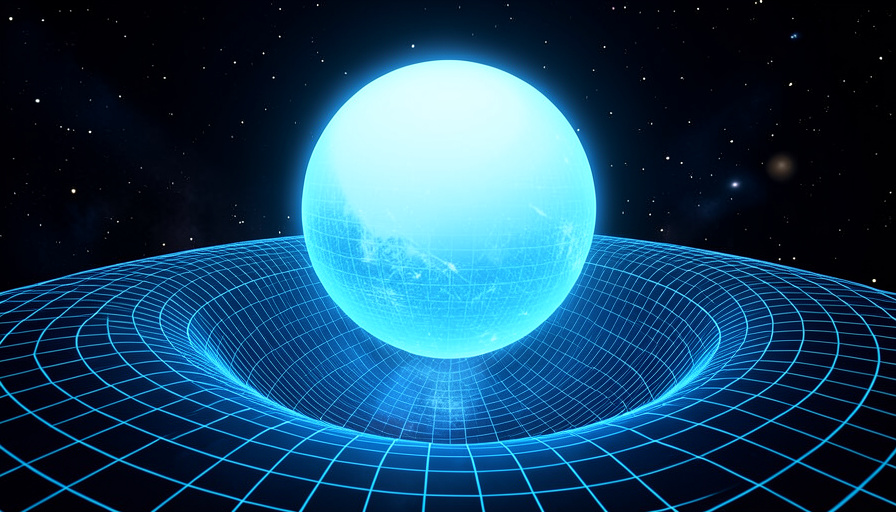
Then Albert Einstein reframed the whole idea. According to the European Space Agency, general relativity treats gravity not as a force but as the geometry of spacetime, with massive objects curving the space and time around them. A common picture is a heavy ball placed on a stretched rubber sheet: it creates a dip, and smaller objects rolling nearby curve toward it.
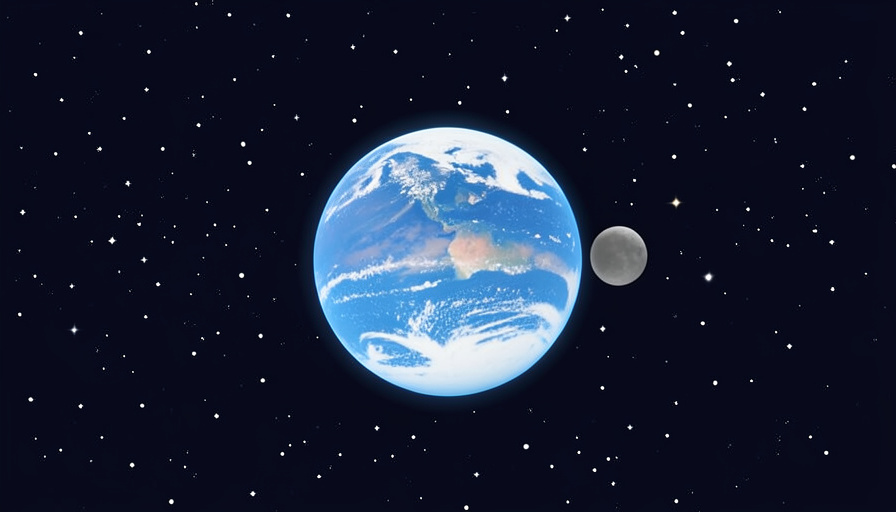
In this view, the Earth does not so much pull the Moon as bend the spacetime the Moon travels through, so the Moon simply follows the straightest available path through that curved space. It sounds abstract, but it makes precise predictions that Newton’s version cannot, and experiments have confirmed them repeatedly. Gravity, it turns out, is woven into the fabric of the universe itself.
Why it shapes the universe
Gravity has a curious status among the forces of nature. Britannica notes that it is the weakest of the four fundamental forces, far feebler than the forces that hold atoms together. You can prove this yourself: a small magnet lifts a paperclip against the entire gravity of the Earth.
Yet gravity is also the most pervasive force, because it acts on all mass and energy and reaches across vast distances. That combination is why it governs the large-scale universe. Gravity pulls clouds of gas together to ignite stars, binds those stars into galaxies, and holds planets in their orbits. Over cosmic time, this quiet, relentless pull has sculpted the structure of everything we can see.
How we experience it
On a human scale, gravity is simply the reason things have weight and fall down. Your weight is really a measure of how hard Earth’s gravity pulls on your mass. On the Moon, which has less mass, that pull is about a sixth as strong, which is why astronauts bounce.
Gravity also explains why astronauts on the space station appear to float. They are not beyond gravity’s reach; in fact Earth’s gravity is nearly as strong up there. Instead, they are in constant free fall around the planet, falling and moving forward at just the right rate to keep circling it. That endless fall is what we call an orbit. To keep exploring the forces at play in space, the story of nebulae shows gravity building stars from clouds of gas.
What to know
- Gravity is the natural force that pulls objects with mass toward one another.
- Its strength grows with mass and weakens with distance, following an inverse square law.
- Newton described gravity as a force of attraction; Einstein showed it is the curving of spacetime by mass.
- Gravity is the weakest fundamental force but the most far-reaching, shaping stars, galaxies, and orbits.
- Weight is a measure of gravity’s pull, and orbiting astronauts float because they are in constant free fall.
Frequently asked questions
What is gravity in simple terms?
Gravity is the force that pulls objects with mass toward each other. It is what keeps you on the ground, makes dropped objects fall, and holds the Moon in orbit around Earth. The more mass an object has, the stronger its gravity, and the pull grows weaker as objects move farther apart.
How does gravity actually work?
Newton described gravity as a force of attraction between masses that weakens with distance. Einstein went further, showing that massive objects curve the fabric of spacetime, and other objects follow that curvature. Both descriptions predict how things move, with Einstein’s being more precise in extreme conditions.
Why is gravity considered weak?
Gravity is the weakest of the four fundamental forces. A small magnet can lift a paperclip against the pull of the entire Earth, which shows how feeble gravity is compared with magnetic and atomic forces. It dominates the universe only because it acts on all mass and reaches across huge distances.
Why do astronauts float if there is still gravity in space?
Astronauts on the space station are not beyond gravity; Earth’s gravity there is almost as strong as on the ground. They appear to float because they are in continuous free fall, moving forward fast enough to keep missing the Earth as they fall. That ongoing free fall is what an orbit is.
Does gravity affect time?
Yes. According to Einstein’s general relativity, stronger gravity slows down the passage of time. This effect, called gravitational time dilation, is tiny in everyday life but real and measurable. Clocks run very slightly slower closer to a massive body like Earth than they do farther away in space.
What this means
Gravity is a rare thing in science: a force everyone experiences constantly and yet almost no one fully pictures. Newton gave us a simple, powerful rule for how masses attract, and Einstein revealed the deeper truth that gravity is the shape of spacetime itself. Both remain useful, one for launching rockets, the other for understanding black holes and the birth of the cosmos. The next time something falls, it is worth remembering that the same gentle pull is holding galaxies together across billions of light-years. For more on the universe and how it works, the Space section has much more to explore.

Related Posts
What Is a Nebula, and How Do Stars Form in One?
What Is the Big Bang, and What Does It Explain?