
What Is DNA, and How Does It Work?
Inside almost every one of your roughly 30 trillion cells sits a molecule so long that, uncoiled, it would stretch about two meters, yet it is packed into a space far too small to see. That molecule is DNA, and it carries the complete set of instructions for building and running a human being, written in a code of just four chemical letters. The same molecule, in different sequences, spells out every living thing on the planet, from bacteria to blue whales.
DNA is one of those words everyone knows but few can actually explain. It is not magic, though; it is elegant chemistry with a simple underlying logic. Here is a clear guide to what DNA is, how it stores information, and how it manages to copy itself.
Quick answer
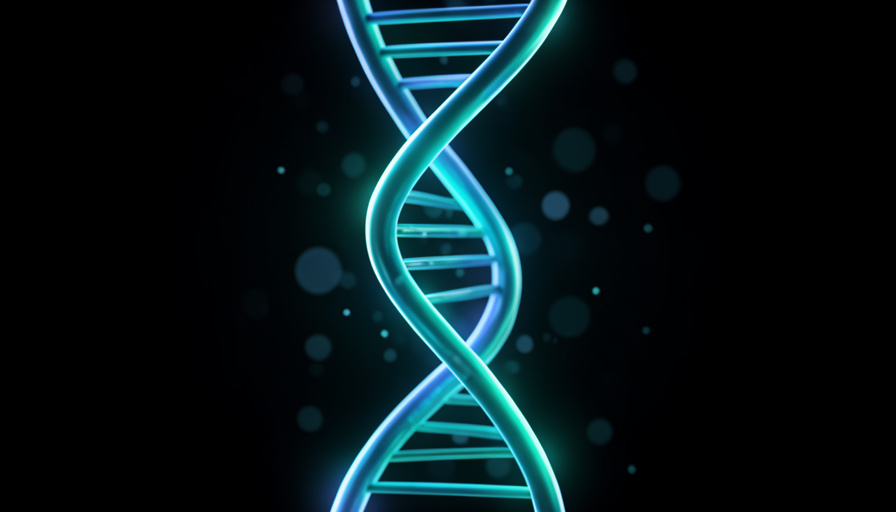
DNA, short for deoxyribonucleic acid, is the molecule that carries the genetic instructions for the development and functioning of living organisms. It is shaped like a twisted ladder called a double helix, and its information is written in a sequence of four chemical bases: A, T, C, and G. The order of those bases spells out genes, the instructions for building proteins and running a cell. DNA can also copy itself, which is how genetic information passes from cell to cell and from parents to offspring.
What DNA actually is
DNA is the hereditary material that carries the genetic code of life. As MedlinePlus Genetics, the consumer resource from the US National Library of Medicine, defines it, DNA, or deoxyribonucleic acid, is the hereditary material in humans and almost all other organisms. In essence, it is a chemical instruction book passed down through generations.
In your cells, most DNA is stored in the nucleus, the cell’s control center, where it is known as nuclear DNA. A small amount also sits inside mitochondria, the structures that produce a cell’s energy, and is called mitochondrial DNA. Wherever it is found, DNA’s job is the same: to hold the coded instructions that tell cells how to build the molecules of life and carry out their work. For more on the physical and living world, browse SciExaminer’s Science section.
The double helix and its four letters
DNA’s famous shape is the key to how it works. As the National Human Genome Research Institute describes it, DNA is made of two linked strands that wind around each other to resemble a twisted ladder, a shape called a double helix, with each strand built on a backbone of alternating sugar and phosphate groups.
The rungs of that ladder are where the information lives. Attached to each sugar is one of four bases: adenine (A), thymine (T), cytosine (C), or guanine (G). These bases always pair in the same way, A with T and C with G, joining the two strands together. That strict pairing is not a minor detail; it is the reason DNA can both store a code and reliably copy it. Just four letters, arranged in different orders, are enough to write the instructions for every living thing.
How DNA stores instructions
The magic is in the sequence. The order of the bases along a strand of DNA spells out biological instructions, much as the order of letters spells out words and sentences. A stretch of DNA that codes for a particular product, usually a protein, is called a gene, and genes are the functional units of heredity.
The scale is staggering. According to the National Human Genome Research Institute, the complete set of human DNA, called the genome, contains about 3 billion base pairs and roughly 20,000 genes, packaged into 23 pairs of chromosomes. Proteins built from these instructions do most of the work in the body, forming structures, speeding up chemical reactions, and carrying signals. In this way, a sequence of chemical letters ultimately shapes everything from your eye color to how your cells function.
How DNA copies itself
For life to grow and reproduce, DNA has to be copied faithfully every time a cell divides, and its structure makes that possible. Because A always pairs with T and C with G, each strand of the double helix carries all the information needed to rebuild its partner.
MedlinePlus explains that DNA can replicate, or make copies of itself, with each of the two strands serving as a template, or pattern, for building a new matching strand. When a cell divides, the double helix unzips down the middle, and the pairing rules let the cell assemble two identical copies, one for each new cell. This elegant mechanism is why your genetic instructions can be passed, almost letter for letter, from a single fertilized cell to the trillions of cells in your body, and on to the next generation.
How we found its shape
The double helix is so familiar now that it is easy to forget it was a hard-won discovery. As Britannica recounts, in 1953 James Watson and Francis Crick proposed that DNA is a double helix of two strands coiled around each other, working in Cambridge, England.
Their model relied heavily on the experimental work of Rosalind Franklin, whose X-ray diffraction images, especially the famous Photo 51, revealed that DNA had a helical shape. Watson, Crick, and Maurice Wilkins received the Nobel Prize for the discovery in 1962, but Franklin, whose data was central to it, had died of cancer in 1958 and was not honored, a history now widely recognized. Understanding DNA’s structure unlocked modern genetics, from decoding the human genome to the gene-based medicine of today.
Key takeaways
- DNA, or deoxyribonucleic acid, is the hereditary material that carries genetic instructions in nearly all living things.
- It is shaped like a twisted ladder, the double helix, with a backbone of sugar and phosphate.
- Its code uses four bases, A, T, C, and G, which pair A with T and C with G.
- The sequence of bases forms genes, and the full human set, the genome, has about 3 billion base pairs and 20,000 genes.
- DNA copies itself by unzipping and using each strand as a template, passing instructions to new cells and offspring.
Frequently asked questions
What is DNA in simple terms?
DNA is the molecule that holds the instructions for building and running living things. It is shaped like a twisted ladder and written in four chemical letters, A, T, C, and G. The order of those letters forms genes, which act like a recipe book for the body.
What are the four bases of DNA?
The four bases are adenine (A), thymine (T), cytosine (C), and guanine (G). They always pair the same way, A with T and C with G, forming the rungs of the DNA ladder. The order of these bases along the strand encodes genetic information.
Where is DNA found in the body?
Most DNA is stored in the nucleus of each cell, known as nuclear DNA, which acts as the cell’s control center. A smaller amount is found inside mitochondria, the parts of the cell that make energy, and is called mitochondrial DNA. Nearly every cell contains a full copy.
What is the difference between DNA and a gene?
DNA is the whole molecule that stores genetic information. A gene is a specific segment of that DNA that carries the instructions for making a particular product, usually a protein. Genes are the functional units of heredity, and the human genome contains roughly 20,000 of them.
How does DNA copy itself?
Because each base pairs with only one partner, A with T and C with G, the two strands carry matching information. When a cell divides, the double helix unzips, and each strand serves as a template to build a new partner strand, producing two identical copies of the DNA.
Final word
DNA is perhaps the most remarkable molecule known, a chemical library that stores the blueprint of life in a language of four letters and copies itself with astonishing precision. Understanding it, the double helix, the base pairs, the genes, turns the abstract idea of heredity into something concrete and almost mechanical. It is the thread that connects you to your parents, to every living thing, and to billions of years of life on Earth. The more we learn to read and edit it, the more of medicine and biology it continues to reshape. For more on the machinery of the body, the Health section digs deeper.

Related Posts

Why Is the Sky Blue? The Science Explained
What Is a Fossil, and How Does One Form?