
What Causes the Northern Lights, and Where to See Them?
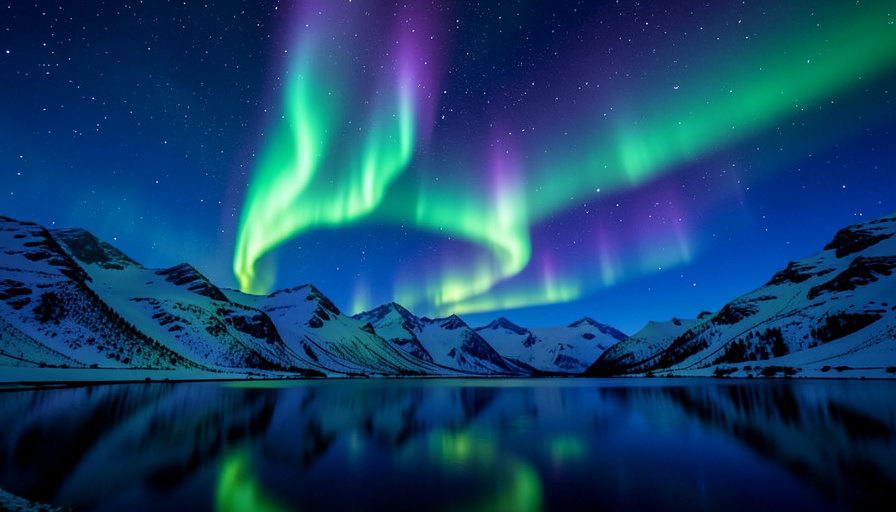
On the right night, in the right place, the sky above the far north catches fire in slow, silent ribbons of green and violet. The northern lights look like magic, but they are actually the Sun reaching across 93 million miles of space to touch our atmosphere. The science behind them is as beautiful as the sight.
The aurora has awed people for as long as anyone has lived under it, spawning myths of spirits and dragons in the sky. We now know exactly what causes it, and understanding the mechanism does nothing to lessen the spectacle. If anything, knowing that you are watching solar particles crash into the air far overhead makes the show more remarkable, not less.
Short answer
The northern lights happen when charged particles streaming from the Sun hit Earth’s magnetic field and get funneled toward the poles, where they slam into gases high in the atmosphere. Those gas atoms absorb the energy and release it as light. Oxygen glows green and red, nitrogen glows blue and purple, and the result is the shimmering curtains we call the aurora.
What actually causes the aurora
It starts at the Sun, which constantly blows out a stream of charged particles called the solar wind. When that stream reaches Earth, our planet’s magnetic field acts like a shield, deflecting most of it. But the field also funnels some of those particles down toward the north and south magnetic poles, which is why auroras ring the polar regions rather than appearing everywhere.
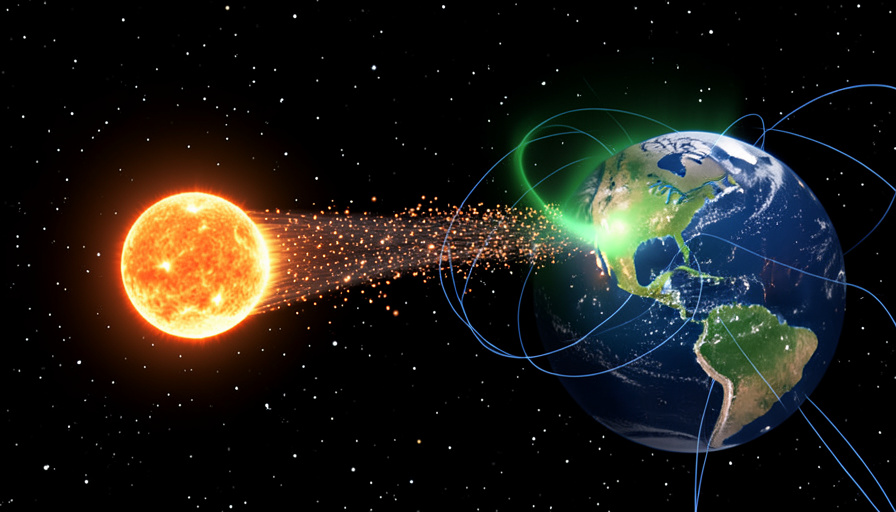
High in the upper atmosphere, those incoming particles collide with atoms of oxygen and nitrogen. As the NOAA Space Weather Prediction Center explains, the collision transfers energy to the gas, and the gas then releases that energy as light. Multiply that by countless collisions across the sky, and you get the glowing sheets of the aurora. The same process at the South Pole produces the aurora australis, the southern lights. For more from beyond our planet, browse SciExaminer’s Space section.
Why the colors change
The aurora’s palette is not random. It depends on which gas is glowing and how high up the collisions happen, which acts like a natural altitude chart written in color.
- Green is the most common color, produced by oxygen at roughly 60 to 150 miles up.
- Red comes from oxygen too, but much higher, above about 150 miles, where the air is thinner.
- Blue and purple come from nitrogen, often fringing the lower edges of the display.
Because green oxygen emissions are the easiest for our eyes to detect, most auroras look predominantly green to the naked eye. Cameras, which gather more light than our eyes can, often reveal reds and purples that were faint or invisible in person, which is why aurora photos can look even more vivid than the real thing.
Why some years are better than others
Auroras are not equally likely every year, because the Sun runs on a roughly 11-year cycle of activity. At the peak, called solar maximum, the Sun is dotted with sunspots and hurls out more frequent bursts of particles known as coronal mass ejections.
During those active years, as Space.com notes, auroras become brighter, more colorful, and visible much farther from the poles than usual. A strong solar storm can push the lights into places that rarely see them, which is why every so often the aurora surprises people at mid-latitudes who never expected a show.
Where and when to see them
Catching the aurora comes down to latitude, darkness, and a little luck with the weather and the Sun. Your best odds are near the auroral zone that circles the magnetic poles.
Prime viewing spots include Tromso in Norway, Abisko in Sweden, Reykjavik in Iceland, Fairbanks in Alaska, and Yellowknife in Canada. Beyond location, a few conditions matter. Go in the darker months, get well away from city lights, and pick a clear night. It also helps to check an aurora forecast, such as the one from the University of Alaska Fairbanks Geophysical Institute, which uses a scale called the Kp index to predict how far south the lights will reach. A higher number means a better chance of a strong display.
Are the northern lights dangerous?
Standing under the aurora is completely safe. The light is happening far overhead, at the edge of space, and poses no threat to anyone watching from the ground. What can cause trouble is the space weather behind a strong display. The same powerful solar storms that light up the sky can disrupt satellites, GPS signals, and radio communications, and a severe storm can even strain electrical grids. A famous 1989 storm knocked out power across the Canadian province of Quebec for hours.
There is also the strange question of whether the aurora makes a sound. For centuries, observers have reported faint crackles or hisses during intense displays, and scientists long dismissed the idea. A small number of recent studies suggest the sounds may be real after all, possibly from electrical discharges near ground level during strong auroras, though the effect is rare and still debated.
Key takeaways
- The aurora is caused by solar particles hitting gases in Earth’s upper atmosphere.
- Earth’s magnetic field funnels those particles toward the poles, so auroras ring the polar regions.
- Oxygen produces green and red light, while nitrogen produces blue and purple.
- Auroras are strongest during solar maximum, the peak of the Sun’s 11-year cycle.
- To see them, head to high latitudes on a dark, clear night and check an aurora forecast.
Frequently asked questions
What causes the northern lights?
Charged particles from the Sun, called the solar wind, strike Earth’s magnetic field and are funneled toward the poles. There they collide with oxygen and nitrogen in the upper atmosphere, and those gases release the energy as the colored light of the aurora.
Why are the northern lights different colors?
The color depends on the gas and the altitude. Oxygen glows green at lower altitudes and red at higher ones, while nitrogen produces blue and purple. Green is the most common because oxygen emissions at that height are easiest for our eyes to see.
When is the best time to see the aurora?
During the darker months at high latitudes, on clear nights away from city lights, and especially during years of high solar activity. Auroras are most active around midnight and can be much stronger during solar storms.
Where can you see the northern lights?
The best places are near the auroral zone at high northern latitudes, including northern Norway, Sweden, Iceland, Alaska, and Canada. During strong solar storms, the lights can occasionally be seen much farther south than usual.
Can you see the aurora with the naked eye?
Yes, though it often looks fainter and greener than in photographs. Cameras capture more light and reveal reds and purples that the eye struggles to detect, so the aurora can appear more colorful in pictures than it does live.
Final word
The northern lights are a rare case where the scientific explanation is every bit as wondrous as the myth it replaced. Each ribbon of light is a record of the Sun’s weather reaching Earth and colliding with the thin air at the edge of space. Chasing them takes patience, a dark sky, and a bit of luck, but standing beneath a full display is one of the great experiences the planet offers. Watch the forecasts, get somewhere dark and far north, and let the Sun paint the sky. For more on the science of the cosmos, the Science section digs deeper.

Related Posts
What Causes Lightning, and Why Thunder Follows

What Is a Connectome? Brain Mapping Explained