How Do Satellites Stay in Orbit Without Falling?
Right now, thousands of satellites are sweeping over your head, from the one that beams your weather forecast to the ones that guide your phone’s map. Earth’s gravity is tugging on every single one. So why don’t they simply drop out of the sky? The answer is one of the most beautiful ideas in physics.
It seems like a paradox. Gravity does not switch off just because you are a few hundred miles up. In fact, it stays almost as strong up there as it is on the ground. Yet satellites circle for years without falling. Understanding how they pull that off explains everything from why the space station floats to why some satellites hover over a single spot.
In brief
A satellite stays in orbit by falling toward Earth and moving sideways so fast that it keeps missing the ground. Gravity constantly pulls it down, but its forward speed curves its path around the planet instead of into it. With almost no air to slow it in space, it can keep circling like this indefinitely, balanced between falling and flying past.
The trick: falling without hitting the ground
The key is that a satellite is not fighting gravity. It is falling, constantly, exactly like a dropped ball. The difference is that it is also racing sideways at enormous speed. By the time it would have fallen to the ground, it has moved so far horizontally that the curved surface of the Earth has dropped away beneath it. It keeps falling and keeps missing, which is what an orbit actually is.
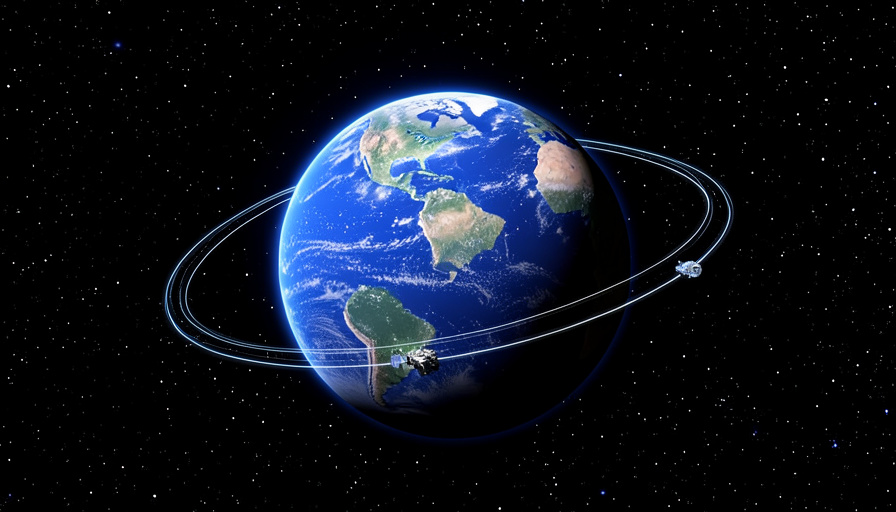
Isaac Newton imagined this centuries ago with a cannon on a mountain, firing a ball ever faster until it circled the world. As NASA explains, a satellite is caught in a permanent tug of war between its forward motion and Earth’s pull, and when the two are balanced it neither escapes nor crashes. This is also why astronauts appear weightless. They are not beyond gravity, they are simply falling around the Earth along with their spacecraft. For more from beyond our planet, browse SciExaminer’s Space section.
Why speed depends on altitude
Orbit is not one single speed. The lower a satellite is, the stronger gravity’s pull and the faster it must travel to keep from falling back. Climb higher, and the required speed drops. This trade between altitude and speed sets the entire menu of possible orbits.
In low Earth orbit, a few hundred kilometers up, a satellite races at roughly 7.8 kilometers per second, close to 17,500 miles per hour, and laps the planet about once every 90 minutes. As Space.com notes, that is the neighborhood of the International Space Station and most imaging and internet satellites. Go much higher, and both the speed and the sense of hurry ease off.
The main types of orbit
Satellites are placed at different heights depending on their job, and the orbits fall into a few broad bands. As the European Space Agency lays out, the three main ones are worth knowing.
- Low Earth orbit. Up to about 2,000 kilometers, fast and close, used by the space station, Earth-imaging satellites, and satellite internet networks.
- Medium Earth orbit. Several thousand to around 20,000 kilometers, home to navigation systems like GPS.
- Geostationary orbit. A very precise altitude of about 35,786 kilometers, where a satellite circles once every 24 hours and so appears to hover over one fixed spot, ideal for television and weather satellites.
That hovering trick of geostationary orbit is not magic. At that exact height the orbital period matches Earth’s rotation, so the satellite and the ground turn together and it stays parked above the same point.
Why they don’t slow down
On Earth, anything moving eventually stops because air and friction rob it of energy. Space is nearly empty, so there is almost nothing to slow a satellite down. Once it is up to orbital speed, it simply keeps going, coasting around the planet without needing engines. That is why a satellite can operate for a decade or more on the momentum it was given at launch.
The catch is the word almost. In low Earth orbit, faint traces of the atmosphere still reach out and create a tiny drag. Over months and years, that thin resistance gradually saps a low satellite’s speed and pulls it lower, which is why craft like the space station need occasional boosts from their thrusters to stay up.
What happens when an orbit decays
When a low satellite is not boosted, that slow drag eventually wins. The satellite sinks into thicker air, heats up from friction, and usually burns up on reentry, with only the largest pieces occasionally reaching the ground. This is a natural cleanup for the lowest orbits.
Higher up, where there is essentially no drag, dead satellites do not fall for an extremely long time, which is part of the growing problem of space junk. Retired hardware and debris can linger for centuries, so operators increasingly plan to move old satellites into disposal orbits or bring them down on purpose. Keeping orbit usable is becoming as important as reaching it in the first place.
What to know
- A satellite stays up by falling toward Earth while moving sideways fast enough to keep missing it.
- Gravity is still strong in orbit, so satellites are not beyond its reach, just balanced against it.
- Lower orbits require higher speed, with low Earth orbit at about 17,500 miles per hour.
- Orbit types include low, medium, and geostationary, each suited to different tasks.
- With little air to slow them, satellites coast for years, though low ones face slight drag and eventually reenter.
Frequently asked questions
Why don’t satellites fall to Earth?
They actually are falling, but they move sideways so fast that the Earth curves away beneath them before they can hit it. This balance between falling and forward motion is what keeps a satellite circling the planet instead of dropping.
Is there gravity in orbit?
Yes. Even hundreds of kilometers up, Earth’s gravity is still roughly 90 percent as strong as at the surface. Satellites and astronauts are not beyond gravity, they are in continuous free fall around the Earth, which is why they appear weightless.
How fast does a satellite travel?
It depends on altitude. In low Earth orbit a satellite travels about 7.8 kilometers per second, or roughly 17,500 miles per hour, completing an orbit in about 90 minutes. Higher orbits require lower speeds.
What is a geostationary orbit?
It is an orbit about 35,786 kilometers above the equator where a satellite circles once every 24 hours, matching Earth’s rotation. From the ground it appears to stay fixed over one spot, which is ideal for communications and weather satellites.
Do satellites ever come back down?
Low ones do. Thin traces of atmosphere create drag that slowly pulls them lower until they reenter and usually burn up. Satellites in high orbits face almost no drag and can remain for centuries, contributing to space debris.
Closing thoughts
The next time you use a map on your phone or watch a satellite weather map, it is worth remembering the quiet physics holding it all up. Every satellite overhead is falling, endlessly, and only its tremendous sideways speed keeps it from ever landing. It is a delicate balance, discovered on paper long before anyone could reach it, and now trusted by the thousands of machines that run modern life from above. For more on how the universe works, the Science section digs deeper.

Related Posts

What Is a Light-Year, and How Far Is It?

How Do the Tides Work, and Why Two a Day?