
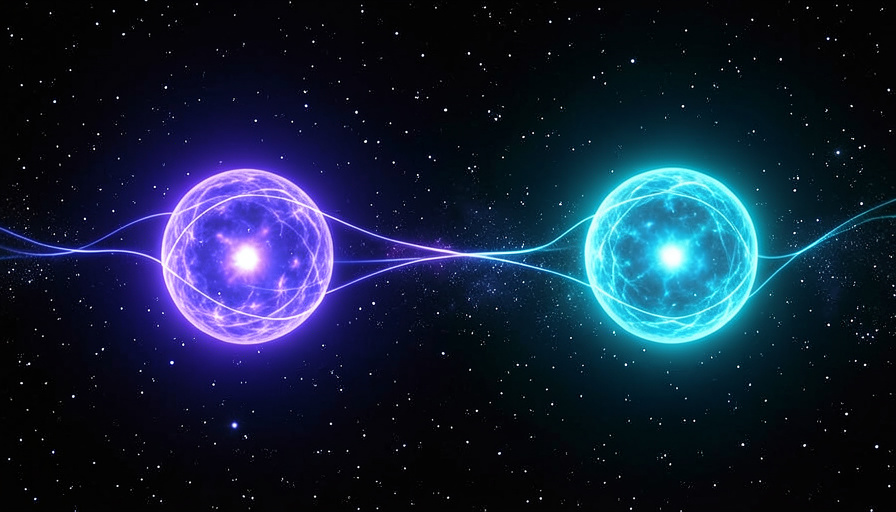
What Is Quantum Entanglement, and Why Is It Strange?
Quantum entanglement sounds like something from science fiction, and even the physicists who discovered it found it hard to accept. Two particles can become so deeply linked that measuring one instantly reveals something about the other, whether they sit side by side or on opposite sides of the galaxy. Einstein was so troubled by this that he called it spooky action at a distance and spent years trying to explain it away. He lost the argument.
Entanglement is now one of the best-tested ideas in physics and the beating heart of the emerging quantum technologies. It is also widely misunderstood, often described as if it allowed instant communication across space, which it does not. Here is what entanglement actually is, how we know it is real, and why it matters.
Quick answer
Quantum entanglement is a link between two or more particles so that their properties are correlated no matter how far apart they are. Neither particle has a definite value for the linked property until it is measured, but the moment you measure one, the result of the other is fixed to match. Einstein doubted this, but experiments have proven it real. Crucially, it cannot be used to send messages faster than light, though it is central to quantum computing and quantum cryptography.
What entanglement actually is
In the quantum world, a particle often does not have a single definite property until it is measured. Take a property like spin: before measurement, a particle can be in a blur of possibilities at once. Entanglement happens when two particles are created or interact in a way that ties these possibilities together.
As the Caltech Science Exchange describes it, entangled particles share correlated properties no matter how far apart they sit, with values that stay uncertain until one is measured. Picture two coins that are guaranteed to land opposite each other. Before you look, each is undecided, but the instant you see one is heads, you know without checking that the other is tails, even if it is light-years away. That linked uncertainty is the strange core of entanglement. For more on the frontiers of physics, browse SciExaminer’s Science section.
Einstein’s spooky action
Entanglement bothered Albert Einstein deeply. In 1935, together with Boris Podolsky and Nathan Rosen, he argued that quantum mechanics must be incomplete, because the alternative seemed absurd: how could measuring one particle instantly affect what you find in another far away? He called it spooky action at a distance.
Their proposed fix was that the particles must carry hidden instructions all along, secret values decided when they were created, so that nothing actually needed to travel between them at the moment of measurement. In this view, the coins were never truly undecided; they were simply set to opposite faces in advance, and quantum theory just failed to describe those hidden settings. For decades, it was unclear whether Einstein or the standard quantum picture was right.
How we know it is real
The debate might have stayed philosophical if not for the physicist John Bell. In 1964, he showed that Einstein’s hidden-instruction idea and standard quantum mechanics predict measurably different results. If particles carried local hidden instructions, the correlations between them could only be so strong; quantum mechanics predicted stronger correlations that would break that limit.

That turned a philosophical puzzle into an experiment. Over the following decades, physicists ran ever more careful versions, and the results came down firmly on the quantum side. As the US National Institute of Standards and Technology reported, a rigorous 2015 test closed the remaining loopholes and confirmed the spooky correlations are genuinely real. The work was honored with the 2022 Nobel Prize in Physics, awarded to Alain Aspect, John Clauser, and Anton Zeilinger for their experiments with entangled photons. Einstein, for once, was wrong.
Why it can’t beat the speed of light
Here is the point that trips almost everyone up. If measuring one particle instantly fixes the other, surely you could use entanglement to send signals faster than light? The answer is a firm no, and the reason is subtle but important.
The catch is that you cannot control the outcome of your own measurement. When you measure your particle, you get a random result, and so does the person with the other one. Only when the two of you later compare notes, over an ordinary channel limited by the speed of light, does the correlation become visible. Neither of you can force a particular result to encode a message, so no usable information ever travels faster than light. Entanglement links the particles, but it does not open a shortcut for communication.
Why it matters
Far from being a mere curiosity, entanglement is the resource that makes a whole class of new technologies possible. In quantum computing, entangled particles called qubits can work together in ways ordinary bits cannot, opening the door to solving certain problems far faster than any classical computer.
It also underpins quantum cryptography, where entanglement can be used to share secret keys in a way that reveals any eavesdropper, and quantum teleportation, which transfers the exact quantum state of one particle to another at a distance. That last term sounds dramatic, but it moves information about a state, not matter or people, so no one is beaming across a room just yet. Still, these tools are turning what began as Einstein’s headache into the foundation of a new technological era.
Key takeaways
- Quantum entanglement links particles so their properties are correlated at any distance.
- Each particle’s value is undecided until measured, then the partner’s result matches instantly.
- Einstein called it spooky action and thought hidden instructions explained it, but he was wrong.
- Bell tests, honored by the 2022 Nobel Prize, proved entanglement is genuinely real.
- It cannot send messages faster than light, but it powers quantum computing and cryptography.
Frequently asked questions
What is quantum entanglement in simple terms?
It is a special link between two or more particles so that their measured properties are correlated, no matter how far apart they are. Before measurement, the values are undecided, but measuring one instantly determines the matching value of the other, as if they share a single connected state.
Did Einstein believe in entanglement?
Einstein accepted that quantum theory predicted it but found it deeply troubling, calling it spooky action at a distance. He argued the theory must be incomplete and that hidden instructions explained the correlations. Later experiments showed his hidden-variable idea was wrong.
Can entanglement be used to communicate faster than light?
No. Although measuring one particle instantly fixes the other, you cannot control your own random result, so you cannot encode a message. The correlation only shows up when the two sides compare results over an ordinary channel limited by the speed of light.
How do particles become entangled?
Particles become entangled when they are created together or interact in the right way, which links their quantum states. A common method is producing a pair of photons from a single source, so the two emerge already sharing correlated properties.
What is quantum entanglement used for?
It is a key resource for quantum computing, where entangled qubits enable new kinds of calculation, and for quantum cryptography, which uses it to share secure keys. It also enables quantum teleportation, the transfer of a quantum state, though not of matter, between particles.
Final word
Quantum entanglement is a rare case where nature turned out to be stranger than even Einstein was willing to believe. Two particles can share a single linked fate across any distance, their correlations real and repeatable, and yet the universe carefully forbids using that link to break its own speed limit. That balance of the bizarre and the orderly is what makes entanglement so fascinating, and now so useful. What began as a thought experiment meant to expose a flaw in quantum theory has become the cornerstone of the technologies that may define the century. For more on how technology grows from pure science, the Technology section digs deeper.

Related Posts

What Causes Lightning, and Why Thunder Follows

What Is a Connectome? Brain Mapping Explained