What Is GDP, and How Is It Measured?
Turn on any economic news and one three-letter word turns up within minutes: GDP. It is used as shorthand for whether the economy is booming or struggling, whether a country is rich or poor, whether the government is doing a good job. For a number that carries so much weight, though, surprisingly few people could explain what it actually counts, or what it misses.
Gross domestic product is the closest thing economics has to a single scoreboard. It is powerful and genuinely useful, but it is also easy to misread. Understanding what goes into it, and what is deliberately left out, makes every economic headline easier to judge. Here is what GDP really is.
The short version
GDP, or gross domestic product, is the total monetary value of all the final goods and services a country produces in a given period, usually a quarter or a year. It is the main measure of the size of an economy, and its change over time is how we judge economic growth. It can be calculated by adding up spending, output, or income, and economists adjust it for inflation to compare years fairly. Useful as it is, GDP says nothing about how wealth is shared or whether people are actually better off.
What GDP actually is
Gross domestic product is a running total of everything an economy produces. As the International Monetary Fund puts it, GDP measures the monetary value of final goods and services produced in a country over a set period of time. That includes the cars, phones, and haircuts bought by households, the machines bought by businesses, and services provided by the government, all added up into one figure.
Because it captures the whole of a country’s output, GDP is treated as the headline gauge of economic size and health. When GDP is rising, the economy is growing; when it falls for a sustained stretch, that is the sort of contraction associated with a recession. It is the number nearly every other economic statistic is measured against. For more on money and markets, browse SciExaminer’s Business section.
Why only final goods count
One word in the definition does a lot of quiet work: final. GDP counts only finished goods and services that reach their end user, and deliberately ignores the intermediate parts that went into making them. This is to avoid counting the same value twice.
Take a car. The steel, the tires, and the electronics that go into it are intermediate goods. If GDP counted the tire when it was sold to the carmaker and again as part of the finished car, the same rubber would be counted twice. So only the final sale of the car is included, because its price already contains the value of all those parts. This focus on final output is what keeps GDP an honest measure of what an economy truly produces.
Three ways to measure it
There is more than one path to the same figure. GDP can be calculated three different ways, and in principle they all arrive at the same total, because one person’s spending is another’s income and both reflect what was produced.
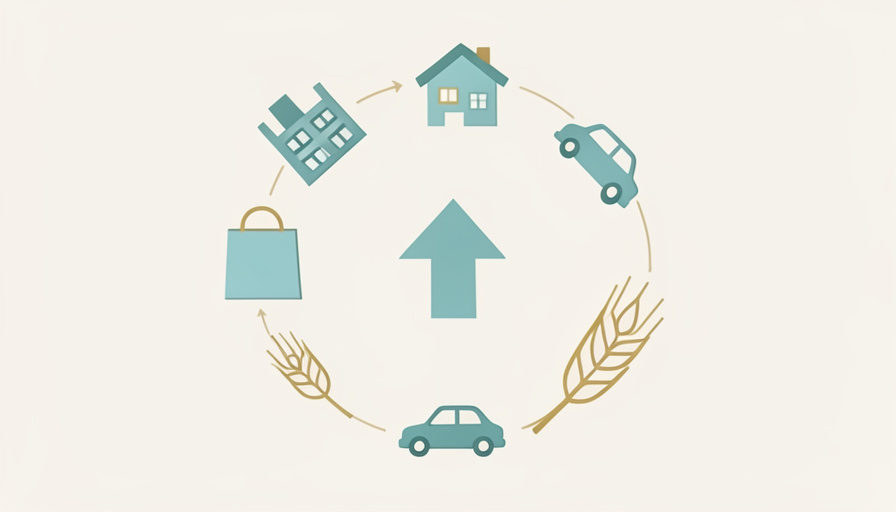
The most familiar is the expenditure approach, which adds up all the spending in an economy: household consumption, business investment, government spending, and net exports, meaning exports minus imports. The production approach instead sums the value added at each stage of making things, while the income approach totals all the wages and profits earned. In the United States, these figures are compiled by the Bureau of Economic Analysis, which publishes the official GDP numbers every quarter. Three routes, one destination.
Real, nominal, and per person
Raw GDP has a catch. If prices rise across the economy, GDP can climb even when the country is producing exactly the same amount, which would make growth look real when it is only inflation. Economists solve this by splitting the figure in two.
Nominal GDP is measured at current prices, while real GDP strips out the effect of price changes to show the actual volume of what was produced. As the Reserve Bank of Australia explains, economists focus on real GDP growth because it reflects genuine changes in output rather than just shifting prices. There is also GDP per capita, which divides total GDP by the population. That gives a rough sense of average output per person and makes it easier to compare a large country with a small one.
What GDP leaves out
For all its usefulness, GDP was never designed to measure how well a society is doing, and treating it that way is a common mistake. It counts the size of the economic pie, but says nothing about how that pie is divided. A country’s GDP can rise while most people feel no better off, if the gains flow mainly to the top.
It also misses a great deal of real value. Unpaid work like caring for children or elderly relatives does not appear in GDP, nor does much of the informal economy, and it takes no account of environmental damage or of whether growth is sustainable. Even the economist credited with developing the measure warned, back in 1934, that the welfare of a nation could scarcely be judged from a figure like national income. GDP is a thermometer for economic activity, not a verdict on a country’s wellbeing.
At a glance
- GDP is the total value of all final goods and services a country produces in a period.
- Only final products are counted, to avoid double-counting intermediate parts.
- It can be measured by spending, production, or income, which in theory all match.
- Real GDP adjusts for inflation, and GDP per capita divides the total by population.
- GDP does not measure inequality, unpaid work, environmental cost, or overall wellbeing.
This article is general educational information, not financial or economic advice. Economic measures like GDP can be interpreted in different ways, and their effect on individual circumstances varies.
Frequently asked questions
What is GDP in simple terms?
GDP, or gross domestic product, is the total value of everything a country produces for final sale over a set period, such as a year. It is the main way economists measure the size of an economy, and its rise or fall over time shows whether the economy is growing or shrinking.
How is GDP calculated?
There are three approaches that should give the same total: adding up all spending (consumption, investment, government spending, and net exports), summing the value added at each stage of production, or totaling all incomes earned. Official agencies compile these figures, usually every quarter.
What is the difference between real and nominal GDP?
Nominal GDP is measured at current prices, so it rises when prices rise even if output does not. Real GDP removes the effect of price changes to show the actual volume produced, which is why economists use real GDP growth to compare one period with another.
What is GDP per capita?
GDP per capita is a country’s total GDP divided by its population. It gives a rough measure of economic output per person and makes it easier to compare countries of very different sizes, though it still says nothing about how income is distributed.
Why is GDP a flawed measure of wellbeing?
GDP measures economic activity, not quality of life. It ignores how wealth is shared, leaves out unpaid work and much of the informal economy, and takes no account of environmental harm. A rising GDP does not guarantee that most people are better off.
What this means
GDP is one of the most useful numbers in public life and one of the most overstretched. As a measure of how much an economy is producing, it is hard to beat, which is why it anchors so much reporting and policy. The trouble starts when it is treated as a scorecard for a nation’s success or happiness, jobs it was never built to do. Read it for what it is, a gauge of output, and it becomes a genuinely clarifying number rather than a misleading one. For more on the ideas that shape the economy, the Science section digs deeper.

Related Posts
What Is a Recession, and How Is One Declared?
How Does Compound Interest Work, and Why It Matters