What Is Dark Matter, and Why Can’t We See It?
Look up at a clear night sky and everything you can see, every star, planet, and wisp of galaxy, adds up to a small fraction of what is actually out there. The rest is invisible. It gives off no light, yet its gravity holds the cosmos together. Physicists call it dark matter, and finding out what it is remains one of science’s biggest unsolved problems.
Dark matter sounds like science fiction, but the evidence for it is decades old and remarkably solid. The strange part is that we can measure how much of it exists and where it sits, while having almost no idea what it is made of. That gap between knowing it is there and knowing what it is defines one of the great frontiers of modern physics.
Bottom line first
Dark matter is an invisible form of matter that does not give off, absorb, or reflect light, so no telescope can see it directly. We know it exists because its gravity affects things we can see, like the way galaxies spin. It makes up about 27 percent of the universe, far more than the ordinary matter that forms stars and planets, and no one yet knows what it is made of.
What dark matter actually is
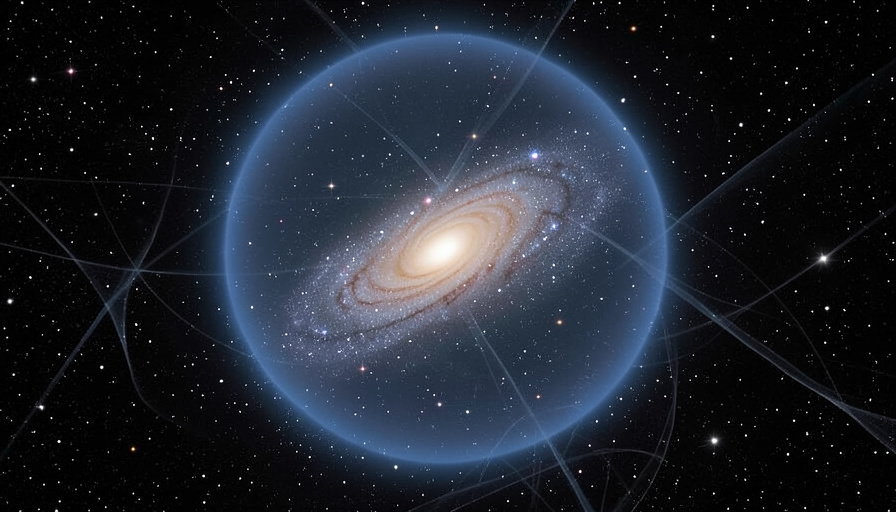
Dark matter is a substance that has mass and gravity but does not interact with light in any way we can detect. Ordinary matter, the kind that makes up you, the Earth, and the stars, glows, blocks light, or reflects it, which is how we see it. Dark matter does none of that, which is exactly why it is invisible and so hard to study.
The scale of it is humbling. As Space.com lays out, the universe is roughly 5 percent ordinary matter, 27 percent dark matter, and 68 percent dark energy, a separate mystery driving the universe’s expansion. In other words, everything we have ever seen or touched is a thin slice of the whole, and most of the matter out there is of a kind we have never held. For more from across the cosmos, browse SciExaminer’s Space section.
How we know it’s there
If dark matter is invisible, it is fair to be skeptical. The confidence comes from several independent lines of evidence that all point the same way. The first was the way galaxies spin. Stars at the edges of a galaxy orbit so fast that the gravity of the visible matter alone should fling them off into space. They stay put only if a large amount of unseen mass is holding them, a discovery driven by the astronomer Vera Rubin.
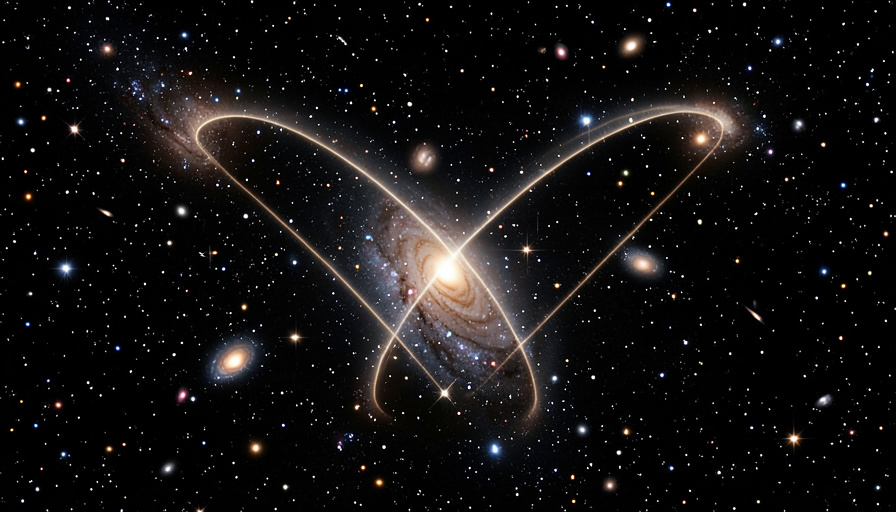
More evidence stacked up from there. Massive clusters of galaxies bend the light of objects behind them, an effect called gravitational lensing, and the amount of bending reveals far more mass than the visible galaxies contain. As NASA notes, the faint afterglow of the Big Bang, the cosmic microwave background, carries the same fingerprint, and its patterns match a universe filled with dark matter. When separate methods, spinning galaxies, bent light, and ancient radiation, all demand the same missing mass, the case becomes hard to dismiss.
What it might be made of
This is where the honesty begins. We can map dark matter’s gravity in detail, yet we do not know what particle it is. It is almost certainly not made of ordinary atoms, since those would interact with light. Physicists have proposed new kinds of particles instead.
The long-standing favorite is the WIMP, short for weakly interacting massive particle, a hypothetical particle that would feel gravity and the weak nuclear force but ignore light. Another leading idea is a very light particle called the axion. As CERN explains, these candidates could in principle be produced or detected in experiments, which is part of why physicists keep hunting for them.
Why we still haven’t found it
For all the confidence that dark matter exists, direct detection has been a long, frustrating quiet. For decades, experiments buried deep underground have waited for a dark matter particle to bump into an ordinary atom, and giant accelerators have looked for it slipping away as missing energy. So far, nothing has been confirmed.
That absence is not proof that dark matter is wrong, but it has ruled out many of the simplest versions and forced physicists to search harder and in new places. A minority of scientists take the null results as a hint that our theory of gravity itself needs tweaking, an idea known as modified gravity. Most researchers still favor dark matter, because no single alternative explains all the evidence as cleanly.
Why dark matter matters
Dark matter is not a cosmic footnote. It is the scaffolding of the universe. In the early cosmos, its gravity pulled ordinary matter together into the first clumps that would grow into galaxies. Without it, the universe we live in, with its galaxies, stars, and planets, would look nothing like it does, if it formed at all.
Understanding it would reshape physics. The particles we know are described by a framework called the Standard Model, and dark matter appears to lie outside it entirely. Whatever it turns out to be, it is a signpost pointing toward physics we have not yet written down, which is why the search draws some of the field’s best minds and largest experiments.
Main takeaways
- Dark matter is invisible matter that has gravity but does not interact with light.
- It makes up about 27 percent of the universe, far more than ordinary matter’s 5 percent.
- We detect it through galaxy rotation, gravitational lensing, and the cosmic microwave background.
- Leading candidates are new particles like WIMPs and axions, none yet confirmed.
- Its gravity built the galaxies, and identifying it would point to new physics.
Frequently asked questions
What is dark matter in simple terms?
It is a form of matter that has mass and gravity but gives off no light, so we cannot see it with any telescope. We only know it exists because its gravity affects visible things, such as how fast galaxies spin. It makes up most of the matter in the universe.
Why can’t we see dark matter?
Because it does not interact with light. It neither emits, absorbs, nor reflects any form of electromagnetic radiation, which is how we normally see things. That makes it invisible to every telescope, and detectable only through the pull of its gravity.
What is dark matter made of?
No one knows for certain. It is almost certainly not ordinary atoms. The leading candidates are hypothetical new particles, especially weakly interacting massive particles, or WIMPs, and lighter particles called axions, but none has yet been detected.
What is the difference between dark matter and dark energy?
Dark matter is invisible mass whose gravity pulls things together and holds galaxies in place. Dark energy is a separate, mysterious force that pushes the universe to expand faster over time. Dark matter is about 27 percent of the universe and dark energy about 68 percent.
How do scientists know dark matter exists?
Several independent observations point to it: galaxies spin faster than their visible mass allows, galaxy clusters bend background light more than they should, and the cosmic microwave background matches a universe full of dark matter. Together these make a strong case.
Closing thoughts
Dark matter is a reminder of how much the universe still keeps from us. We have weighed it, mapped it, and traced its influence back to the birth of galaxies, and yet the simplest question, what is it, remains open after half a century of looking. That is not a failure of science but a live edge of it. Somewhere in a deep underground lab or a future telescope’s data, the answer may be waiting, and it would rewrite part of physics when it arrives. For more on the science of the cosmos, the Science section digs deeper.

Related Posts

How Do the Tides Work, and Why Two a Day?
How Do Satellites Stay in Orbit Without Falling?