


Stand on a beach long enough and you will watch the sea quietly take back the sand you were sitting on. A few hours later it hands it back. This slow breathing of the ocean happens twice a day, almost everywhere, and it is being conducted by the Moon, a quarter of a million miles overhead.
Tides feel local, a thing that belongs to your particular beach and its particular timetable. But the cause is astronomical. The rise and fall of coastal water is the ocean responding to the gravity of the Moon and the Sun as the Earth spins beneath them. Once you see the mechanism, the tide table on the pier stops being a mystery and starts being a clock.
Quick answer
Tides are the daily rise and fall of the sea, caused mainly by the Moon’s gravity. The Moon pulls the ocean toward it and raises a bulge of water on the near side of Earth, while inertia leaves a matching bulge on the far side. As the planet rotates through these two bulges, most coasts pass through two high tides and two low tides roughly every 24 hours and 50 minutes. The Sun adds a smaller pull that makes tides stronger or weaker through the month.
What a tide actually is
A tide is the regular rise and fall of the sea surface at the coast. When the water climbs up the shore it is high tide, and when it drains back down it is low tide. In many places the gap between the highest and lowest water, called the tidal range, is a meter or two, but in some bays it can be enormous.
The important idea is that tides are waves, though very strange ones. They are the crests and troughs of a bulge of water that stretches across an entire ocean, so long and slow that you never see it as a wave at all. You only notice its edge, sliding up and down your local beach on a timetable that repeats with remarkable precision.
Why the Moon raises two bulges
Gravity from the Moon reaches across space and tugs on everything on Earth, including the oceans. Water is free to move, so it flows very slightly toward the Moon, piling up into a bulge on the side of Earth facing it. That much feels intuitive. The puzzle is the second bulge, on the opposite side of the planet, pointing away from the Moon.

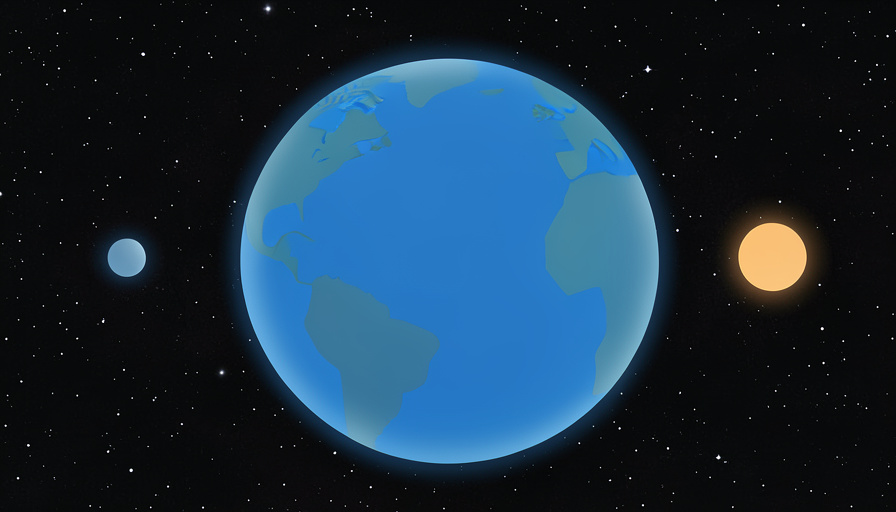
According to NOAA’s National Ocean Service, the far-side bulge comes down to inertia. The Moon does not pull equally on every part of Earth, because gravity weakens with distance. It pulls hardest on the near-side ocean, a bit less on the solid planet at the center, and least of all on the far-side ocean. In effect the Moon drags the whole Earth a touch toward itself, and the water on the far side, feeling the weakest pull, gets left behind and bulges outward. Two bulges, on opposite sides, is the result. For more from beyond our planet, browse SciExaminer’s Space section.
Why most coasts get two tides a day
Here is where the two bulges turn into a daily rhythm. The bulges stay lined up with the Moon while the Earth rotates underneath them once a day. So any given coastline is carried through both bulges and both of the low points in between over the course of a day, giving two high tides and two low tides. This pattern, the most common one, is called a semidiurnal tide.
The timing has a neat twist. A full cycle takes about 24 hours and 50 minutes, not a flat 24, which is why high tide creeps roughly 50 minutes later each day. The reason is that the Moon is moving too. While Earth spins once, the Moon travels a little way along its own orbit, so a coast has to rotate for an extra 50 minutes or so to catch back up with it. That makes successive high tides arrive about 12 hours and 25 minutes apart.
Spring tides and neap tides
The Moon sets the basic beat, but the size of the tides changes across the month, and that is the Sun’s doing. The Sun raises its own pair of tidal bulges, weaker than the Moon’s, and depending on where the Moon sits in its cycle the two either reinforce each other or fight.
As NASA describes it, the strongest tides come when the Sun, Earth, and Moon line up, at new Moon and full Moon. The solar and lunar pulls add together and produce the largest range between high and low water. These are called spring tides, a name that has nothing to do with the season and simply means the water springs up high. They happen about twice a month.
- Spring tides occur at new and full Moon, when Sun and Moon align and their pulls combine for the biggest tidal range.
- Neap tides occur at the first and third quarter Moon, when the Sun sits at a right angle to the Moon and partly cancels its pull, giving the smallest range.
So over roughly a month the tides swing from lively to mild and back again, tracking the phases of the Moon you can see in the sky. The tide and the moonlight are two faces of the same orbit.
The Sun’s quieter role, and why places differ
It seems strange that the Sun, vastly more massive than the Moon, plays second fiddle here. The answer is distance. Tidal pull depends not on gravity alone but on how sharply that gravity changes from the near side of Earth to the far side, and that difference falls off very steeply with distance. The Sun is so far away that its tide-raising effect is a little under half the Moon’s, even though its overall gravity is far greater.
Geography does the rest. The clean picture of two smooth bulges gets reshaped by the size of ocean basins, the slope of the seabed, and the outline of the coast, which can amplify or mute the tide dramatically. As National Geographic notes, some funnel-shaped bays concentrate the water into ranges of many meters, while some seas barely register a tide at all. A few places even get just one high and one low a day. The Moon writes the schedule, but every coast performs it in its own way.
At a glance
- Tides are the daily rise and fall of the sea, driven mainly by the Moon’s gravity.
- The Moon raises one water bulge on the near side and, through inertia, a second on the far side.
- Earth rotating through both bulges gives most coasts two high and two low tides a day.
- A tidal cycle runs about 24 hours 50 minutes, so high tide shifts roughly 50 minutes later each day.
- Spring tides at new and full Moon are strongest; neap tides at the quarter Moons are weakest.
Frequently asked questions
What causes tides?
Tides are caused mainly by the Moon’s gravity acting on the ocean, with a smaller contribution from the Sun. The Moon pulls water into a bulge on the side of Earth facing it, and inertia creates a matching bulge on the opposite side. Earth’s rotation then carries coasts through these bulges.
Why are there two high tides a day?
Because there are two tidal bulges on opposite sides of Earth, one facing the Moon and one facing away. As the planet rotates once a day, most coastlines pass through both bulges, producing two high tides and two low tides. This is the common pattern known as a semidiurnal tide.
Why does high tide happen later each day?
A tidal cycle takes about 24 hours and 50 minutes rather than a flat 24, so high tide arrives roughly 50 minutes later each day. The extra time exists because the Moon moves along its orbit while Earth spins, so a coast must rotate a little further to line back up with it.
What is the difference between spring and neap tides?
Spring tides happen at new and full Moon, when the Sun and Moon align and their pulls add together for the largest tidal range. Neap tides happen at the quarter Moons, when the Sun works against the Moon and the range is smallest. The cycle repeats about twice a month.
Does the Sun affect the tides?
Yes, but less than the Moon. The Sun raises its own tidal bulges, though its tide-raising effect is a little under half the Moon’s because it is so far away. The Sun mainly controls whether tides are strong or weak through the month rather than their basic timing.
Final word
The tide is one of the few places in everyday life where you can watch astronomy happen in real time. That damp line the sea leaves on the sand is the edge of a bulge raised by an object hundreds of thousands of kilometers away, arriving on a schedule set by the Moon’s orbit and fine-tuned by the Sun. Next time you check a tide table before a walk or a swim, it is worth remembering that you are reading a clock wound by the sky. For more on how the universe shapes the everyday, the Science section digs deeper.