


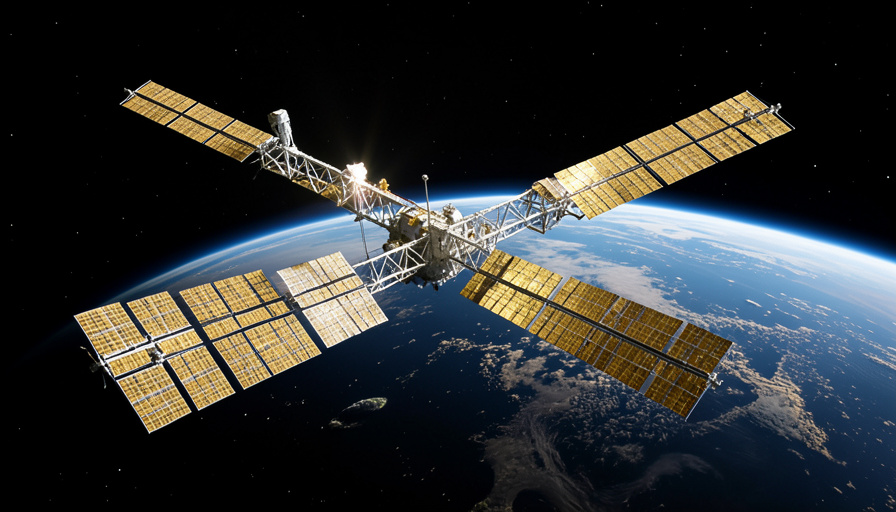
Right now, roughly 400 kilometers above your head, a structure the size of a football field is racing around the planet at five miles a second. Inside it, a small crew of astronauts is running experiments, exercising, and looking down at the Earth through a window. Someone has been living up there, without a single day’s break, since before some of the people reading this were born. That structure is the International Space Station.
The ISS is one of the most ambitious things humanity has ever built, and one of the most quietly taken for granted. It is a laboratory, a home, and a symbol of cooperation, assembled in orbit by nations that are not always friends on the ground. Here is what it actually is and what goes on aboard it.
In brief
The International Space Station is a large, permanently crewed spacecraft that orbits Earth as a science laboratory. It flies about 400 kilometers up, circling the planet roughly every 90 minutes at around 28,000 kilometers per hour. It is a partnership of five space agencies from more than a dozen countries, and it has been continuously occupied since November 2000. Its main job is research in microgravity, and it serves as a testbed for future missions deeper into space.
What the ISS actually is
At its simplest, the International Space Station is a science laboratory that happens to be in orbit. It is the largest structure humans have ever placed in space, roughly the size of a football field including its sprawling solar arrays, and it was built piece by piece, with modules launched separately from Earth and joined together in orbit starting in 1998.
It is not a rocket or a passing spacecraft but a permanent outpost, designed for people to live and work aboard for months at a time. As the European Space Agency describes it, the ISS is a permanently inhabited station in low Earth orbit and the world’s largest international cooperative programme in science and technology. Think of it as a research base that never lands. For more from beyond our planet, browse SciExaminer’s Space section.
Where it flies and how fast
The station orbits in what is called low Earth orbit, at an average altitude of about 400 kilometers, or 250 miles. That is high above aircraft and weather, but still close enough that faint traces of atmosphere create a little drag, so the station occasionally fires thrusters to keep from slowly sinking.
Its speed is hard to picture. According to NASA, the ISS circles the Earth roughly every 90 minutes at about 17,500 miles per hour, which means the crew sees around 16 sunrises and sunsets every single day. It is also bright enough that, on a clear evening, you can spot it from your backyard with the naked eye, a steady point of light gliding silently across the sky.
A partnership of nations
The ISS is not owned by any single country. It is run jointly by five space agencies: NASA in the United States, Roscosmos in Russia, the European Space Agency, JAXA in Japan, and the Canadian Space Agency, drawing on the contributions of around 15 nations.

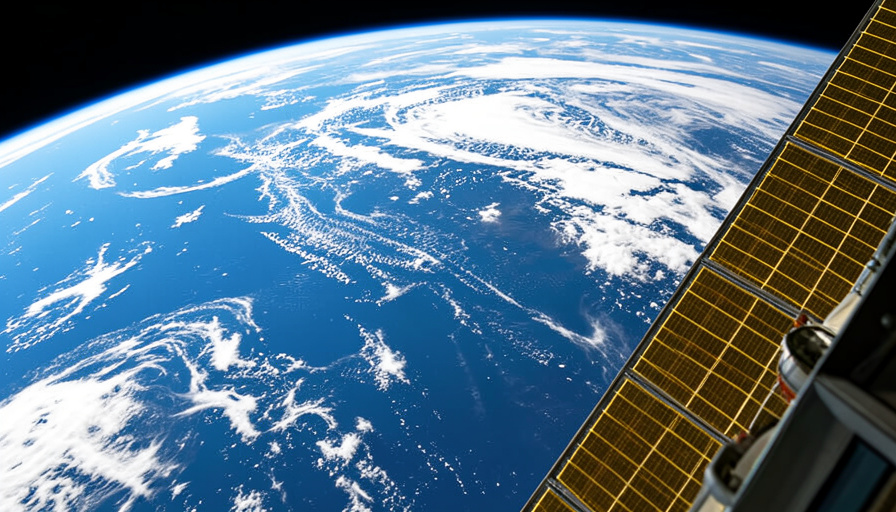
Each partner contributed different pieces. The station carries several laboratory modules, including the American Destiny lab, Europe’s Columbus, and Japan’s Kibo, which the Japan Aerospace Exploration Agency describes as its crewed experiment facility. Canada supplied the station’s iconic robotic arm, used to grab visiting spacecraft and help with construction. That so many countries built and still operate the ISS together, across political tensions on the ground, is a large part of what makes it remarkable.
What happens on board
The reason for all this effort is the strange and valuable condition the station provides: near weightlessness, usually called microgravity. Because the ISS and everything in it are in constant free fall around the Earth, objects float, and that opens up experiments impossible to run on the ground.
Researchers use it to study how the human body changes in space, how flames, fluids, and crystals behave without gravity pulling them down, and how materials and biology respond to the space environment. The station is also a proving ground for the technology and human endurance needed for long journeys to the Moon and Mars. Alongside the science, the crew spends hours each day exercising to fight the muscle and bone loss that weightlessness causes, and carrying out the endless maintenance a machine this complex demands.
Continuous life, and the future
Perhaps the most quietly astonishing fact about the ISS is its continuity. Since November 2000, there has been at least one person living aboard it at all times, an unbroken human presence in space stretching across more than two decades. The crew, usually around seven people, rotates in and out, with astronauts typically staying about six months.
The station will not last forever. It is aging, and the partners plan to retire it around the end of this decade, guiding it down in a controlled reentry over a remote stretch of the Pacific Ocean. When that happens, its role is expected to pass to a new generation of commercial space stations. For now, though, the ISS remains the brightest example of what people can build when they pool their efforts and point them upward.
What matters most
- The ISS is a permanently crewed science laboratory orbiting about 400 kilometers above Earth.
- It circles the planet roughly every 90 minutes at about 17,500 miles per hour.
- Five space agencies from around 15 countries built and operate it together.
- Its main purpose is research in microgravity and preparing for deep-space missions.
- It has been continuously occupied since November 2000 and is due to retire around 2030.
Frequently asked questions
How high does the International Space Station orbit?
The ISS orbits at an average altitude of about 400 kilometers, or roughly 250 miles, in low Earth orbit. At that height it is well above aircraft but still experiences slight atmospheric drag, so it periodically boosts its orbit to avoid gradually falling lower.
How fast does the ISS travel?
The station moves at about 28,000 kilometers per hour, or roughly 17,500 miles per hour. That speed lets it circle the entire Earth about every 90 minutes, so astronauts on board witness around 16 sunrises and 16 sunsets in a single day.
Who owns the International Space Station?
No single country owns it. The ISS is a partnership of five space agencies, NASA, Roscosmos, the European Space Agency, JAXA, and the Canadian Space Agency, involving around 15 nations that each contributed different modules and systems.
What do astronauts do on the ISS?
They mainly conduct scientific research that takes advantage of microgravity, from human biology to physics and materials science. They also maintain the station, test technology for future missions, and exercise for hours daily to counter the muscle and bone loss caused by weightlessness.
Can you see the ISS from Earth?
Yes. Because it is large and reflects sunlight, the ISS is visible from the ground with the naked eye. It appears as a bright, steady point of light moving quickly across the sky, usually shortly after sunset or before sunrise, and its passes can be predicted.
Closing thoughts
The International Space Station is easy to forget precisely because it works so reliably, orbiting overhead year after year while life continues below. But it is worth remembering what it represents: a permanent human foothold in space, a laboratory that has quietly advanced medicine and physics, and proof that rival nations can build something extraordinary together. The next time you catch a bright dot sliding across the evening sky, there is a good chance you are watching people at work, 400 kilometers up. For more on the science behind spaceflight, the Science section digs deeper.