


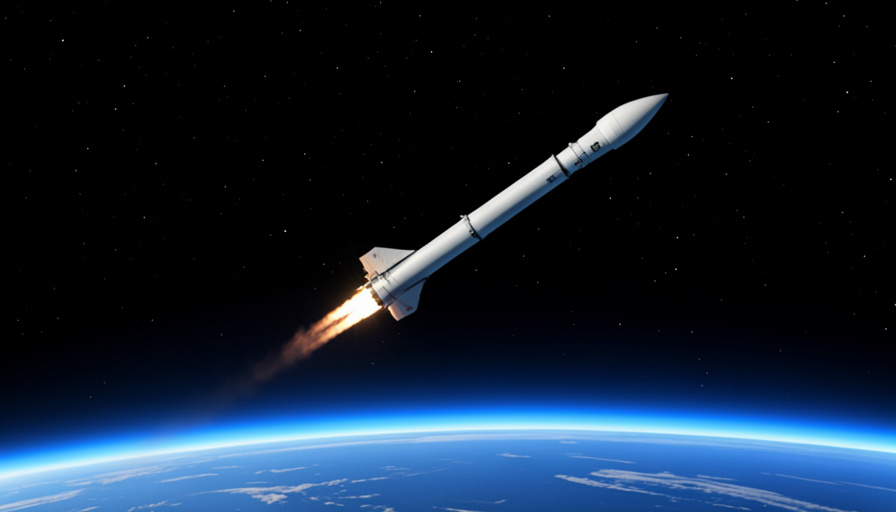
Ask most people how a rocket gets to space and they will point straight up. That is the intuitive answer, and it is mostly wrong. The hard part of reaching orbit is not going up at all. It is going sideways, terrifyingly fast.
We watch a launch and see a tower of fire climbing into the sky, so it feels obvious that reaching space is about altitude. But an object sitting still at the edge of space would simply fall right back down. What keeps a satellite up there for years is not height. It is speed, aimed in a direction that surprises almost everyone the first time they hear it.
Quick answer
A rocket reaches orbit by climbing above the thick lower atmosphere and then accelerating sideways to roughly 17,500 miles per hour. At that speed, the spacecraft falls toward Earth continuously but moves forward so fast that it keeps missing the ground, circling the planet instead of hitting it. Getting high enough is easy. Getting fast enough is what takes an enormous rocket.
Going up is the easy part
Space is closer than most people think. The Kármán line, the widely used boundary where space begins, sits at 100 kilometers, about 62 miles up. That is a long way, but reaching that altitude on its own is a modest task. A powerful enough rocket can lob something to that height the way you might throw a ball straight up, and amateur and suborbital vehicles do exactly that.
The catch is what happens next. Something that goes straight up and runs out of speed does one thing: it falls straight back down. Touching space for a few minutes, which is what a suborbital flight does, is a different achievement from staying there. As Space.com lays out, staying in low Earth orbit demands a specific and very high sideways speed, and that is where the real engineering begins.
How fast is fast enough?
To hold a stable low orbit, a spacecraft has to travel at around 7.8 kilometers per second, close to 17,500 miles per hour. That is roughly 25 times the speed of a passenger jet, and it is the number that makes orbit so demanding.
Isaac Newton pictured this centuries before anyone could build it. He imagined a cannon on an impossibly tall mountain firing a ball horizontally. Fire it gently and it arcs down and lands nearby. Fire it harder and it lands farther away. Fire it hard enough and the ground curves away beneath the ball as fast as the ball falls, so it never lands. It just keeps falling around the world. That is an orbit, and as NASA explains, a satellite is doing precisely that, forever caught in a balance between its forward motion and Earth’s pull. For more from beyond our atmosphere, browse SciExaminer’s Space section.
Why rockets tip over on the way up
Watch a launch closely and you will notice the rocket does not keep going straight up. Within a couple of minutes it leans over and starts flying more and more sideways. That maneuver, called a gravity turn, is the whole game.
The rocket climbs vertically at first only to punch quickly through the dense lower atmosphere, where air resistance is fiercest. Once it is high enough that the air is thin, it pitches over and pours most of its remaining energy into building horizontal speed. By the time the engines cut off, the vehicle is moving nearly parallel to the surface far below. All that fire and thunder is in service of going fast sideways, with altitude almost a side effect.
Why a rocket is almost all fuel
Reaching 17,500 miles per hour is brutally expensive in terms of propellant. A rocket has to carry every bit of fuel it will burn, and that fuel has weight, which means it needs still more fuel to lift the fuel. The result is a vehicle that is mostly tank. On a typical launcher, something like 85 to 95 percent of the liftoff weight is propellant, with the actual payload a tiny sliver at the top.

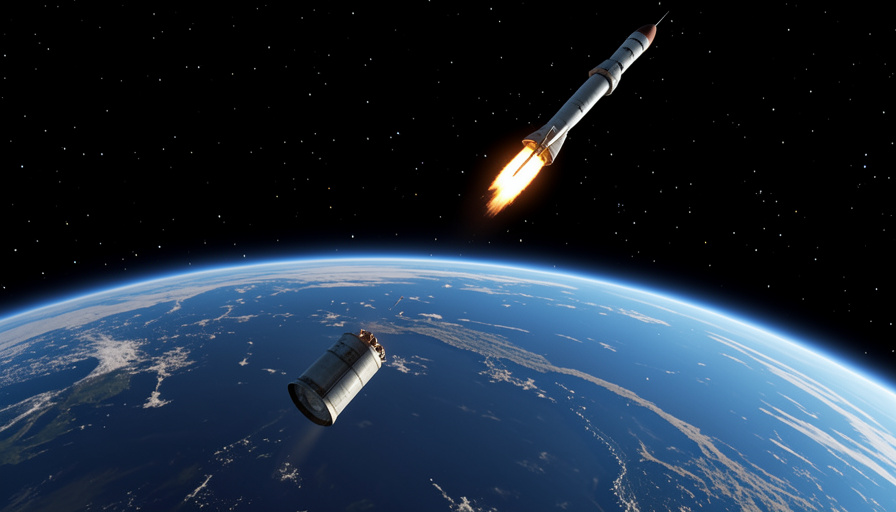
This is why almost every orbital rocket is built in stages. Once the first stage burns through its fuel, its empty tanks and engines are dead weight, so the rocket drops them and lights a smaller upper stage. Shedding the empty hardware means the vehicle stops wasting energy hauling metal it no longer needs, which is the only practical way to reach orbital speed. It also explains the puzzle of how rockets work in a vacuum at all. They do not push against air. Following Newton’s third law, they throw mass out the back at high speed and get shoved forward in return, which works just as well in empty space.
Orbit versus leaving Earth for good
Orbit is a balance, so it is worth separating it from actually escaping Earth. Reaching orbit means going fast enough sideways to keep circling. Leaving Earth entirely, on a path to the Moon or Mars, means going faster still, past what is called escape velocity, roughly 11.2 kilometers per second or about 25,000 miles per hour.
Below that speed you remain bound to Earth, looping around it. At or above it, you break free of its gravitational grip and coast away into deep space. As Encyclopaedia Britannica notes, escape velocity depends on the mass of the body you are leaving, which is why launching from the smaller, lower-gravity Moon takes far less speed than launching from Earth.
At a glance
- Reaching the edge of space at 100 kilometers is relatively easy. Staying there is not.
- A stable low orbit requires a sideways speed of about 17,500 miles per hour.
- Orbit means falling toward Earth continuously while moving forward fast enough to keep missing it.
- Rockets tip over during ascent to convert their thrust into horizontal speed.
- Escaping Earth’s gravity entirely takes an even higher speed, around 25,000 miles per hour.
Frequently asked questions
How fast does a rocket need to go to reach orbit?
About 7.8 kilometers per second, or roughly 17,500 miles per hour, to hold a low Earth orbit. That sideways speed is what lets a spacecraft fall around the planet continuously instead of falling back to the ground.
Why do rockets launch straight up if orbit is about going sideways?
They go up first to get through the dense lower atmosphere quickly, where air resistance is strongest. Once above most of the air, they tip over in a gravity turn and spend the rest of their fuel building the horizontal speed that orbit actually requires.
Why are rockets so big if the payload is small?
Because reaching orbital speed takes a huge amount of fuel, and that fuel has weight that needs even more fuel to lift. On most launchers, 85 to 95 percent of the liftoff weight is propellant, leaving only a small fraction for the payload.
What is the difference between orbit and escape velocity?
Orbital velocity, about 17,500 miles per hour for low orbit, keeps you circling Earth. Escape velocity, about 25,000 miles per hour, is the higher speed needed to break free of Earth’s gravity entirely and travel to the Moon or beyond.
How do rockets work in the vacuum of space?
They do not push against air. By Newton’s third law, a rocket throws mass, its exhaust, out the back at high speed and is pushed forward in return. That reaction works the same in a vacuum as it does in the atmosphere.
Closing thoughts
The next time you watch a launch, keep your eye on the moment the rocket leans over and starts to fly sideways. That quiet pitch, not the fireworks of liftoff, is the part that gets it to orbit. Space travel is less about conquering height and more about a precise, punishing sprint to 17,500 miles per hour, held in a permanent free fall that never quite reaches the ground. It is one of the most elegant ideas in physics, hiding inside one of its loudest machines. For more on how the universe works, the Science section digs deeper.