


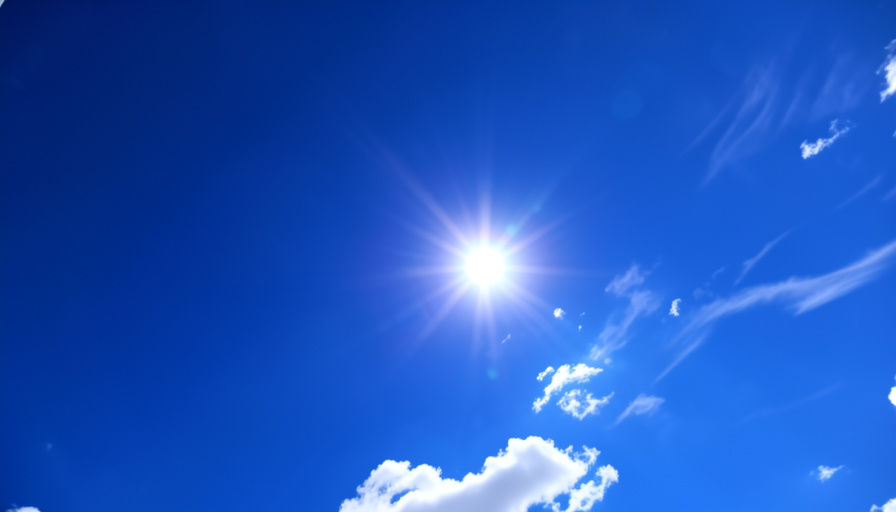
Ask a child why the sky is blue and you will probably stumble. It seems like it should be obvious, yet the real answer has nothing to do with the sky being painted or reflecting the ocean. It comes down to a quiet piece of physics that plays out overhead every single day: the way sunlight bounces off the tiny molecules of air. The same effect that paints the midday sky blue also sets the evening on fire with red and orange.
The explanation is genuinely satisfying once it clicks, and it ties together light, color, and the atmosphere in a neat package. Here is why the sky is blue, why it is not violet, and why sunsets look so different from noon.
Short answer
The sky is blue because of a process called Rayleigh scattering. Sunlight looks white but is actually made of all the colors of the rainbow. As it passes through the atmosphere, it collides with tiny gas molecules in the air, which scatter the shorter, bluer wavelengths far more than the longer, redder ones. That scattered blue light bounces around the sky in every direction, so when you look up, blue is what you see coming from all over.
Sunlight is every color at once
The first thing to understand is that sunlight is not really white. It only looks that way. In truth, sunlight is a blend of all the colors of the visible spectrum, from violet and blue at one end to orange and red at the other. You see this whenever a rainbow or a prism splits daylight back into its separate colors.
What sets the colors apart is their wavelength. Blue and violet light travel in short, tight waves, while red and orange light travel in longer, more stretched-out ones. This difference in wavelength turns out to be the whole key, because it decides how each color behaves when it runs into the air. For more on the physical world, browse SciExaminer’s Science section.
How Rayleigh scattering works
As sunlight streams into the atmosphere, it meets countless molecules of nitrogen and oxygen, the gases that make up most of the air. These molecules are far tinier than the wavelength of visible light, and when light this size hits particles that small, it gets scattered, or redirected, in all directions.

The crucial detail is that this scattering is not equal for every color. As NASA explains, blue light is scattered more than the other colors because it travels as shorter, smaller waves. In fact, Britannica notes that the amount of scattering is inversely proportional to the fourth power of the wavelength, which means short blue waves are scattered dramatically more than long red ones. So blue light gets flung all across the sky, reaching your eyes from every direction, while red light mostly travels straight through. The result is a dome of blue overhead.
Why the sky is not violet
Here is a puzzle that trips people up. Violet light has an even shorter wavelength than blue, so it is scattered even more strongly. By that logic, the sky should look violet, not blue. Yet it does not, and the reason lies partly with the sun and partly with us.
Sunlight contains less violet than blue to begin with, and some violet is absorbed high in the atmosphere. Just as importantly, our eyes are simply more sensitive to blue than to violet, so even where violet is scattered, we barely register it. As the atmospheric scientists behind NOAA‘s work on sky color point out, if human eyes responded differently, the clear daytime sky might well appear violet. The blue we see is the combination of what is scattered and what our eyes are built to notice.
Why sunsets turn red
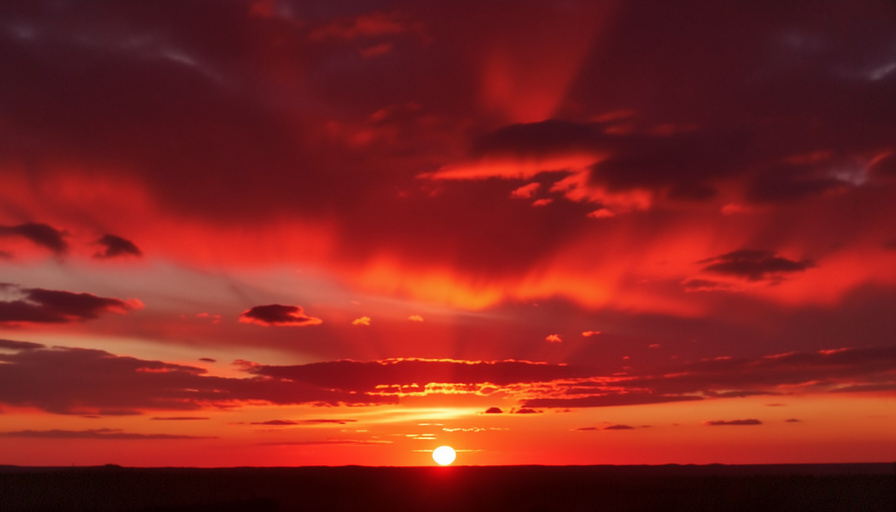
The same physics that makes a blue midday sky also explains the fiery colors of sunset, just flipped around. When the sun sits low on the horizon, its light has to travel through much more atmosphere to reach you than when it is directly overhead.
Over that longer path, nearly all the blue light gets scattered away, bounced off in other directions long before it arrives. What is left to reach your eyes is the light that resists scattering, the reds, oranges, and yellows with their longer wavelengths. That is why the sun and the sky around it glow warm at dusk. In a neat twist, sunsets are red for exactly the same reason the daytime sky is blue: blue light scatters easily, and red light does not.
The pale horizon and other worlds
Look toward the horizon on a clear day and the blue often fades to a washed-out, whitish pale. That happens because light coming from low in the sky passes through far more air, so the blue is scattered and rescattered so many times, and mixed with light bouncing off the ground, that the colors blend back toward white.
The effect even reaches other planets. Because sky color depends on what is in the atmosphere and how sunlight scatters through it, a different world produces a different sky. On Mars, with its thin, dusty air, the daytime sky looks butterscotch or pinkish, and sunsets there can glow an eerie blue, the reverse of ours. Our familiar blue sky, in other words, is a signature of Earth’s particular air and light, not a given of the universe.
What to know
- Sunlight is a mix of all colors; blue and violet have short wavelengths, red and orange long ones.
- Air molecules scatter short blue wavelengths far more than long red ones, a process called Rayleigh scattering.
- Scattered blue light fills the sky from every direction, so we see blue overhead.
- The sky looks blue rather than violet because sunlight has less violet and our eyes favor blue.
- At sunset, light travels through more air, blue scatters away, and the remaining reds and oranges glow.
Frequently asked questions
Why is the sky blue in simple terms?
Sunlight contains all colors, and blue light travels in shorter waves that bounce off tiny air molecules far more than other colors. This scattered blue light spreads across the whole sky, so when you look up, you see blue coming from every direction. The effect is called Rayleigh scattering.
Why is the sky not violet if violet scatters more?
Violet light is scattered even more than blue, but the sky still looks blue for two reasons. Sunlight contains less violet than blue, and some is absorbed high up. More importantly, human eyes are more sensitive to blue than violet, so we perceive the sky as blue.
Why are sunsets red and orange?
At sunset, sunlight passes through much more atmosphere to reach you. Along that longer path, the blue light is almost entirely scattered away, leaving mainly the longer-wavelength reds, oranges, and yellows to reach your eyes. That is why the sky glows warm near the setting sun.
What is Rayleigh scattering?
Rayleigh scattering is the scattering of light by particles much smaller than its wavelength, such as gas molecules in air. It affects short, blue wavelengths far more than long, red ones. Named after Lord Rayleigh, it is the reason the daytime sky is blue and sunsets are red.
Is the sky blue on other planets?
Not necessarily. Sky color depends on a planet’s atmosphere and how sunlight scatters through it. Mars, with thin, dusty air, has a butterscotch daytime sky and can show bluish sunsets. Earth’s blue sky is a result of our specific mix of gases and sunlight.
Closing thoughts
The blue sky is one of those everyday marvels that hides real physics in plain sight. Once you know that sunlight is every color, that blue scatters most, and that our own eyes tip the balance, the whole daily cycle makes sense, from the deep blue of noon to the burning red of dusk. It is a rare case where the honest scientific answer is just as beautiful as the mystery it replaces. The next clear day, it is worth a glance upward, knowing exactly what you are seeing. For more on the cosmos and how we see it, the Space section digs deeper.