


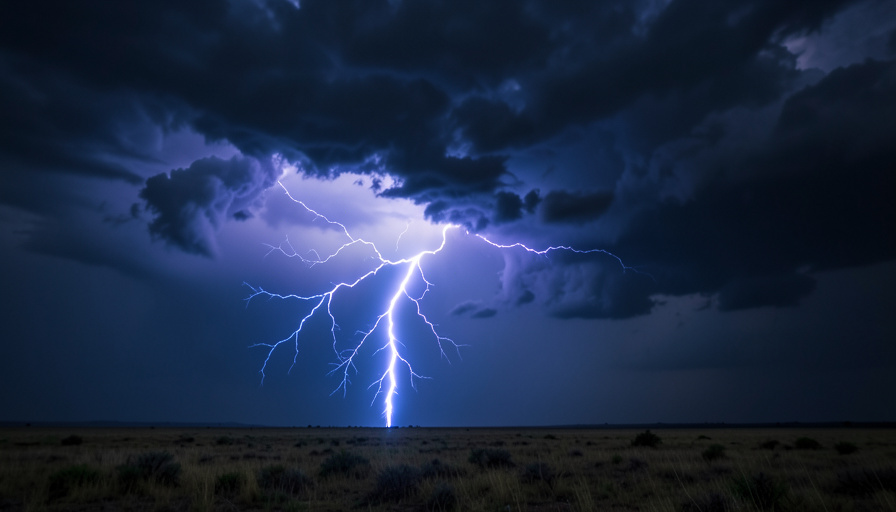
A bolt of lightning is one of nature’s most violent everyday events. In a few thousandths of a second it dumps a huge electrical charge through the air and heats a narrow channel to around five times the temperature of the Sun’s surface. And it all begins with something almost gentle: tiny bits of ice bumping into each other inside a towering storm cloud.
We have watched lightning with fear and fascination for as long as there have been people, yet the basic science of what causes it is not widely understood. It comes down to static electricity on a massive scale, the same effect that makes your hair stand up, scaled up until the sky itself discharges. Here is how a thunderstorm builds and releases that charge.
Short answer
Lightning is a giant electrical spark caused by a buildup of electric charge inside a storm cloud. As ice crystals and softer ice pellets collide in the cloud’s powerful updrafts, they separate positive and negative charges to opposite ends of the cloud. When the difference grows large enough to overpower the air’s resistance, the charge suddenly discharges as a bolt, either inside the cloud or down to the ground. That bolt heats the air so fast that it explodes outward, and the shockwave is what we hear as thunder.
What lightning actually is
At its heart, lightning is an electrical discharge, the same phenomenon as the small spark you feel when you touch a doorknob after walking across a carpet. The difference is one of scale. A carpet shock involves a tiny voltage over a centimeter. A lightning bolt involves hundreds of millions of volts across a gap that can stretch for miles.
Most lightning actually happens inside or between clouds, never reaching the ground at all. The cloud-to-ground strikes we picture are the dramatic minority. In every case, though, the cause is the same: a large separation of electric charge that the atmosphere eventually neutralizes in a sudden, brilliant flash. For more on the forces shaping our world, browse SciExaminer’s Science section.
How a storm cloud builds up charge
Lightning is born in tall storm clouds called cumulonimbus, the anvil-topped giants of a thunderstorm. Inside them, strong updrafts hurl water droplets upward into freezing air, where they turn into ice crystals and small, soft hail pellets called graupel. These particles are constantly colliding as they rise, fall, and mix.

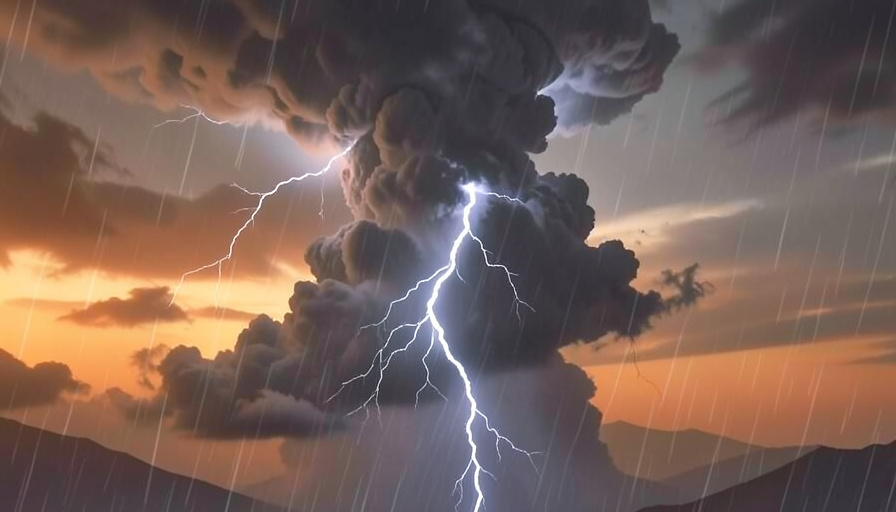
Those collisions are the key. As NOAA describes, when the lighter ice crystals bump against the heavier graupel, charge is transferred between them. The small ice crystals tend to carry positive charge and get swept toward the top of the cloud, while the heavier graupel picks up negative charge and sinks toward the bottom. The result is a cloud that behaves like a giant battery, strongly positive up high and negative down low. The ground beneath the storm, in turn, becomes positively charged. All that separated charge is a coiled spring waiting to release.
The moment the spark jumps
Air is normally a good insulator, which is why the charge can build for a while without going anywhere. But there is a limit. Once the voltage between the charge regions grows strong enough to break down the air in between, a conducting path opens and the discharge begins.
In a cloud-to-ground strike, a faint, branching channel called a stepped leader pushes down from the cloud in rapid jumps. As it nears the surface, an upward streamer of opposite charge reaches up to meet it, often from a tall object. When the two connect, they complete a circuit, and a massive surge of current called the return stroke races back up the channel, producing the blinding flash we see. It happens so fast that the several strokes making up a single bolt look to us like one flickering flash.
Why lightning makes thunder
Thunder is the sound of lightning’s violence. The return stroke carries an enormous current through that narrow channel of air, and according to the UK Met Office, it heats the air to around 30,000 degrees Celsius almost instantly, roughly five times hotter than the surface of the Sun.
Air that hot expands explosively, slamming into the cooler air around it and sending out a shockwave. That shockwave, spreading out and fading into a rumble, is thunder. Because light travels far faster than sound, you see the flash almost instantly but hear the thunder later. That delay is a handy ruler: count the seconds between the flash and the bang, divide by five, and you get the distance to the strike in miles. A shorter gap means a closer, and more dangerous, bolt.
Staying safe in a storm
Lightning is beautiful from a safe distance and genuinely deadly up close, so a word on safety belongs here. The simple rule promoted by weather agencies is easy to remember: when thunder roars, go indoors.
As the US National Weather Service stresses, if you can hear thunder at all, you are already within range of a strike, since lightning can travel several miles from its parent storm. The safest place is inside a substantial building or a hard-topped vehicle with the windows up. Once indoors, stay away from corded electronics, plumbing, and windows, and wait about 30 minutes after the last thunder before heading back out. There is no safe place outdoors in a thunderstorm, which is why getting inside is the only reliable protection.
What matters most
- Lightning is a large-scale electrical discharge, the same basic effect as a static shock.
- Colliding ice crystals and graupel in storm clouds separate positive and negative charge.
- When the charge difference overcomes the air’s resistance, it releases as a bolt.
- The bolt heats air to about 30,000 degrees Celsius, and the explosive expansion makes thunder.
- Count the seconds between flash and thunder and divide by five for the distance in miles.
Frequently asked questions
What causes lightning in simple terms?
Lightning is caused by a buildup of electric charge in a storm cloud. Colliding ice particles separate positive and negative charges to opposite ends of the cloud, and when the difference gets large enough, the charge discharges as a giant spark, either within the cloud or to the ground.
Why does lightning cause thunder?
The lightning channel heats the surrounding air to around 30,000 degrees Celsius in an instant. That air expands explosively and creates a shockwave, which we hear as thunder. A sharp crack means the strike was close, while a long rumble means it was farther away.
Why do you see lightning before hearing thunder?
Light travels far faster than sound, so the flash reaches you almost immediately while the thunder takes longer. You can estimate the distance by counting the seconds between the flash and the thunder and dividing by five to get the number of miles.
Does most lightning hit the ground?
No. Most lightning occurs inside a single cloud or between clouds and never reaches the ground. Cloud-to-ground strikes, the ones people usually picture, are actually the less common type, though they are the most dangerous to people and property.
How can I stay safe during a thunderstorm?
Follow the rule “when thunder roars, go indoors.” If you can hear thunder, you are within striking range. Shelter in a solid building or a hard-topped vehicle, avoid corded electronics and plumbing, and wait about 30 minutes after the last thunder before going back outside.
Final word
Lightning is a reminder that the sky is an electrical machine, quietly building and releasing charge on a scale that dwarfs anything we plug into a wall. What starts as ice crystals jostling in a cloud ends as a bolt hotter than the Sun’s surface and a clap of thunder you feel in your chest. Understanding the mechanism does not make a storm any less spectacular, but it does make it less mysterious, and it points to the one sensible response when the thunder starts: get inside and enjoy the show from a window. For more on the weather and the planet, the Environment section digs deeper.